Showing posts with label class acts. Show all posts

Sunday, February 20, 2011

Hierophant Druids: The Elemental Power Source is among us!

This week in Dragon magazine has seen the release of Class Acts: Hierophant Druids, yet another piece by Rob J. Scwhalb which, while solid enough (as all things Schwalb) would not be particularly remarkable on its own merits: it features some really nice and original flavor, but I found the mechanics that support it to be rather mediocre. That is, except for the little fact that they introduce a new power source to the game...

Unless I'm missing some obscure paragon path out there, the three powers featured in this article are the only ones in the game with the Elemental keyword - and I don't even know if there's any specific name for spells of the elemental power source (like divine powers are called prayers, and martial ones are exploits). And two of them aren't even fully elemental, but a combination of elemental and primal. So it's not like we can figure out the contents of an upcoming Elemental Power book from that (or rather, Heroes of the Elemental Chaos, if we follow the most recent naming pattern).

But there are some things we can tell about elemental, even from this tiny sample. The mere fact that they haven't dismissed the idea altogether, and that they are willing to release material related to it is encouraging - we didn't get to see anything labeled as 'ki' before that power source got axed, after all. We won't see any elemental-themed class in print this year, though - that much we can tell from the current release schedule (something about which I should write one of these days, by the way), which has Heroes of Shadow and Heroes of the Feywild as the only player-oriented releases for 2011. But, as I speculated above, it does look like a sign that we should expect a similar product inspired by the Elemental Chaos somewhere around 2012.

What can elemental offer, as a power source? I am a bit torn about it... on the one hand, I find the whole element concept pretty cool, and there is a lot that can be done with the four classic elements. Also, I just love how it all fits in the 4E cosmology, as the primordials are engaging villains, and the Elemental Chaos is a much more interesting place to visit than the plain old monochromatic, single-element planes found in the old Great Wheel. But is that enough to support cool new character concepts?

This is the greatest strike against an elemental power source, for me. I really can't think of a fantasy archetype that would make for a great elemental class. Sure, we have had our share of placeholder role/power source combinations in 4E, like Invokers and Wardens, which felt a bit too forced at first. But at least we had clerics and druids as strong pillars to base their respective power sources. Is there any concept out there that could fill that gap for elemental? Like the wizard is to arcane, or the fighter to martial?

It's not that the four elements lack design space - in fact, the opposite is true. But they have already seen so much use in other power sources, that maybe there's not a clear niche left. Arcane has always been strongly related to the idea of huge explosions of fire, ice, lightning and whatever it is that earth does these days. I am of the opinion that you can't do anything with fire that's cooler than the good old fireball, anyways. And primal magic also makes good use of the elements, usually spicing them up with some animal themes. Hell, even divine characters get to have some elemental fun every other day, particularly of the lightnign and thunderstorm variety. And any of them can choose to focus on a single element, or just use any number of them, so our fledging elemental class can't even hold to that.

The solution we have seen in the powers from the Hierophant Druid article (all three of them) is to introduce powers that use all four elements at once. Or, rather, a choice of one of the four each time you cast them. The implementation in this article isn't particularly brilliant, and I'm afraid the basic idea is flawed: you are just spreading the power too thin. It's difficult enough to come up with a power effect that is original, fun, and balanced - designing something with four variations that fill these criteria, and are somehow related but different enough from each other is a painful task. And it's not even particularly rewarding! I guess the added flexibility is welcome, and at least you can tell it's a different power source because nobody tried the four-elements-in-one shtick before, but what is the point? I honestly think any of these powers would be better off if they had focused on one, or maybe two of the elements.

So, what else could they do? I think that having powers that combine two or more elements in one single effect (rather than presenting a bunch of bland options) could have some potential. It's the same idea that led to the creation of hybrid elemental monsters in Monster Manual I: it still feels elemental, but opens up a ton of possibilities. Sure, single-element monsters (or, in this case, powers) feel more iconic, but they have also been done to death by now. I still don't see how this could be used as the basis for three or four classes, but it's better than nothing...
Read More......

Monday, February 14, 2011

Bards of Wolfstone

With Dragon magazine content growing more and more scarce in the last months, I don’t get much in the way of great articles to review. Thankfully, this month has brought us a small gem, in the form of a class article for melee bards called Bards of Wolfstone. Signed (like so much DDI material) by Robert Schwalb, the article is short (four new powers, three feats, and a couple pages of backstory), but makes up for it with a combination of polished mechanics and imaginative ideas.

Rules-wise, this article is remarkable in its lack of filler items. Granted, it would seem like this is an easy accomplishment when you are only delivering a handful of feats and powers, but I had grown accustomed to rates of 50% or higher subpar or unplayable items, regardless of article size. Here, there is only one skill-centric feat I’d be inclined to dismiss, and even that one provides enough utility so as to be useful in games where Intimidate checks are relevant.

We get four new encounter attacks for melee, weapon-using bards, distributed across all tiers. They all share the peculiarity of counting as both primal and arcane attacks (since an affinity for primal magic is the defining characteristic of the Wolfstone Bards referenced in the title), but are otherwise conventional bard powers. The mere fact that they are playable melee weapon attacks is good enough news for many bard players, as the range of options for melee builds of the class was pretty slim. Mechanically, these powers are based on the creation of zones that last for a turn, boosting you and your allies or punishing enemies that end their turns there. The fact that these zones work regardless of the attacks hit or not makes the powers particularly attractive.

Rounding up the article are three new feats available to bards of any build. My favourite is Battle Cadence, which boosts the sliding effect of your Majestic Word while providing a small damage bonus. Wild Virtue is also rather nice, as it grants free movement when your bardic virtue is triggered. Finally, Words of Wrath is the least impressive of the three, as it affects intimidate checks - but, that said, it has a strong effect if you do use that skill.

As for the article flavor, it has a clearly nordic inspiration, with bards leading barbaric tribes against frost giants and similar creatures on frozen regions. Interestingly, it follows up on a previous Dragon article (the also excellent Humans of the Wild, from Dragon 386) which introduced the community of Wolfstone. This is a rare case of continuity between Dragon issues, and I’d like to see more like it. There is even some mechanical continuity at work here, as the article cites yet another previous source (Class Acts: Bard. in Dragon 376) as including an ideal paragon path for this particular breed of bards. Of course, the fact that Mr. Schwalb is the author behind all these articles doesn’t hurt, and less prolific writers would have a harder time trying to pull this off.
Read More......

Friday, July 2, 2010

Class Acts: Monk - Pushing the boundaries of Full Disciplines.

UPDATE: Darn, the errata bugbear hit this article hard! It turns out that movement techniques with immediate actions were deemed too confusing, after all, as they all got changed to minor action shifts in the compilation. Good news is, minor action movement techniques are still there, and the article is still full of awesome.

I haven’t been writing much about Dragon Magazine lately, due to the overall mediocrity of last month’s content. Only two of the articles in June's issue (#388) were of interest to me: an intriguing Winning Races for Dragonborn, featuring an alternate encounter power for the race (which you can take without any kind of feat cost, an idea I fully support, and which I’d like to see more of), and a Class Acts dedicated to fire Wizards that introduced some cool ideas, but irregular mechanics.

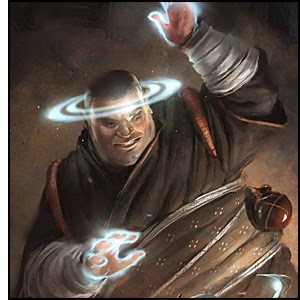
It seems like issue #389 may be a different story, though, as we start the month with a great article for the Monk class, signed by Peter Schaefer. Subtitled "Fallen Needle Itinerants", the article features some amusing backstory on a monk master called Fat Aloisus, as well as really inspired mechanics. I already talked about my love for monks when we got to see one half of the class and, after reading the rest, I think they are easily the best thing to come out of Player’s Handbook 3, and one of the coolest strikers in the whole game. However, there is one thing that PHB3 didn’t get completely right but this article redeems: the use of Full Disciplines.

Don't let him deceive you, it's all muscle. Really.

For those not versed in the Way of the Monk, a full discipline is a special kind of attack that actually includes two powers in one: an attack technique, and a movement technique. The attack technique is pretty much your standard 4E attack power, but the other one is the cool part - a special mode of movement that can only be used on the same round you use the associated attack, typically granting effects such as increased movement speed or shifting, but also jumps, teleports, switches, and other tricks that you’d expect from utility powers.

The Full Discipline mechanic shows a lot of potential, as both parts of a power can be tied thematically or mechanically, having special synergies with one another and even resulting in powers with sub-standard attacks that are nevertheless worth taking due to a strong movement effect. Unfortunately, we didn’t get to see too much of this in PHB3 - but this short article makes up for it in spades.

The greatest innovation of the new powers in this Class Acts (one At-Will and six Encounters) lies in breaking an unwritten rule of Movement Techniques: that they have to cost a Move Action. By using triggered free and immediate actions, and even minor actions, these disciplines add even more variety and dynamism to your monk, and can result in great frustration for monsters trying to engage in melee.

This kind of powers can be a little confusing, in that many players tended to assume that you could only activate a movement technique in the same round as the corresponding attack technique. However, looking closely at the rules text, we find that the limitation is actually to use them in the same round, so it’s perfectly possible to use the reaction moves as long as you made an appropriate attack during your turn. Also, you should be aware that the rules only prevent you from using different full disciplines, but nothing stops you from spending your standard action on a different kind of attack (like basic attacks or multiclass powers) and choosing any of your at-will movement techniques. This should prove particularly useful for hybrid characters.

Anyway, I hope we can see more DDI material of this quality in the future. Now I just need to get my hands on a monk PC, to try out the new stuff...
Read More......

Saturday, May 22, 2010

Class Acts: Invoker. More feats than you can fit in a Burst 2.

One of the best articles in DDI so far this month has been the Class Acts dedicated to Invokers. It's one of those increasingly rare, mechanics focused articles, offering little in the way of backstory, but full of new options - the ones I'm always looking for. Signed by the prolific and reliable Robert J. Schwalb, this article consists purely of feats, of all tiers and colors. With a total of 34 invoker-specific feats, this is more than the whole Divine Power book added to the class in that regard, unless we count Domain feats. So the number of possible combinations and builds for the class has been greatly expanded - opening up some very intriguing concepts.


Dubious Manifestation is a new feat of dubious quality for Drow Invokers

There's something I should get out of the way first, though. A dozen of these are racial feats- not a bad thing per se, as it actually covers the races that had been left out in previous supplements. And they are terrible. Not all of them are strictly unplayable (though many are), but they manage to be consistently bland, situational, and often pointless. The formula of 'gain a small bonus when you use your racial power' is abused to death, and almost always disappoints. It's not that it's impossible to make exciting feats with one-shot encounter effects, but they aren't even trying too hard - combat advantage, forced movement, small amounts of damage or even a +1 bonus to a single attack roll are far too weak benefits to be worth the effort.

The few racial feats that do something different are way more acceptable, though not spectacular: the changeling one, Flexible Covenant, allows you to change covenants each day, and the shifter feat Mobile Covenant lets you shift huge distances as your covenant benefit. Nevertheless, the racial stuff feels like mere filler, overall.

After that, things get more interesting. Way more interesting. The remaining feats develop certain themes, such as improvement of summons, specialization in ranged attacks, mastering the staff implement and granting covenant-specific benefits.

Of these, perhaps the most interesting are the ones thatenhance your summoningprayers. With a name like 'invoker', one would have expected a class with better support for powers that bring creatures to the battlefield, so there was quite a gap to fill. Thankfully, the feats are excellent:Carceri's Manacles slows enemies around summoned creatures, whereasRighteous Summons grants a different benefit depending on the character's covenant: attack penalties for maledictors, ally sliding for preservers and, my personal favourite, extra damage for wrathful invokers. To round it off, we have a general purpose feat that will greatly benefit summoners inHand of Fury, which grants extra attacks when a daily attack fully misses.

The feats that reward the use of ranged power are very intriguing because, unlike other controllers, invokers are very strong in this department (mostly because of *Hand of Radiance* and similar multi-target shots). Heaven's Arrow grants a bonus to hit against isolated targets - a condition that isn't usually that easy to meet, but which has quite a bit of synergy with the free slides from Covenant of preservation. Interestingly, it is a scaling feat bonus, as if tempting players to take the feat instead of Expertise. I don't think anyone will get that far, but it is something to consider. The remaining ranged feats are Angelic Harrier, which makes your dailies and encounters slide, and Vanguard's Eye, which grants protection against opportunity attacks.

Staff wielders will get to play a very different style of controller by taking Staff of Channeled Invocations, a feat that turns ranged powers into melee attacks. Among other cool combinations, this allows invokers of the Skill Domain to use Divine Bolts as opportunity attacks, in what may be the first realistic application of the power since it was mostly obsoleted by Hand of Radiance. The other staff feat, Pillar of Heaven, is also interesting but much more limited in scope, as it should only be useful to invokers relying on single-target ranged powers in their encounter slots.

As for the different Covenants, Malediction gets the most new options, with four feats. Of these, Crushing Doom looks particularly impressive, placing a significant damage penalty on all targets of your Maledictor's Doom power. The other covenants get three feats each, of which the paragon feats Preserver's Fury (target of Preserver's Rebuke becomes vulnerable to all damage) and Wrathful Outburst (Armor of Wrath targets an additional enemy) stand out the most.

Finally, the epic tier presents three generic feats that every Invoker should consider taking.Invoker Implement Expertise, as its name suggests, is the boring yet useful option to boost the crit range for all class powers.Dreadful Invocation is a truly spectacular feat that makes your critical hits from encounter or daily attacks inflict a lasting attack penalty, as well as forcing the target to move away from you (with the subsequent opportunity attacks). The last one, Reaching Invocation, works with area attacks, allowing you to target additional foes adjacent to the area - the Invoker's equivalent to Enlarge Spell, and a reason to maybe try Vanguard's Lightning over Hand of Radiance once you gain access to it.

To sum up, an amazing, useful and deep article. If you play an Invoker, chances are that you'll end up using several of the feats included here.
Read More......

Thursday, April 8, 2010

Class Acts: Warlock. Charisma for Infernal Pact?

This month, in Dragon magazine, Warlocks get another amazing article. No, really. Again. It definitely looks like someone at Wizards is badly in love with Warlocks. Of the tiefling variety. And is Lead Designer of the game, and thus allowed to do silly things, like using Charisma for Infernal Pact powers, and get away with it.

It's cool to be with the charismatic boys!

Yes, intrepid reader! The days where Star Pact Warlocks sat lonely as the one class build with weird stats have come to an end, as the Infernal Pact joins the club. Of course, the devil is in the details, because this time the designers have not forgotten to provide an alternate at-will for charismatic characters. This power, called Gift to Avernus, is a very nice clone of Eldritch Blast which features a shiny new mechanic from hell: taking damage to reroll an attack.

Let us take a close look at this mechanic, because it is shared by all the powers introduced in this article. The base idea is simple: when you miss, take damage and make a new attack roll. The question that most sensible Warlocks should be making by now is not 'why would I use a spell that hurts me', but 'how much damage, did you say?'. We're talking about practical people, after all.

The cost is equal to your level in HP. This is a real bargain at the very first level, but don't be fooled by that anomaly - it soon stabilizes into something closer to 10-15% of your total health. Depending on your tier, this may or may not be more than a round's worth of monster damage. That's quite a lot! This makes focusing on these powers a risky proposition, unless you are just not being attacked, or you somehow have a bunch of extra HP lying around. Enter Dark One's Blessing.

Isn't it an amazing coincidence that the infernal warlock's pact boon grans them exactly the temporary hit points they'd need to pay for a reroll with these powers? The existence of this feature drastically changes our evaluation of these powers, from something dangerous and probably not worthwhile, to a good outlet for the absurd amounts of THP you naturally gained, and usually wasted. If you ever feel that you won't have enough temporaries to consistently support this, just add Bloodied Boon...

With that out of the way, what do the powers look like? The at-will, in my opinion, is a very good proposition, leaving the reroll as an option, and granting full effect if you hit the second time. As for the encounter powers (one for each level), they are a bit trickier, since they actually force you to take the damage, and then only repeat the attack against a different enemy, and with reduced damage. Nevertheless, I think they are well worth the pain.

Reliability with damaging attacks is important for a striker, and most of these powers deal more than enough damage by themselves (in addition to granting extra chances for your curse damage). But it is probably even better when you are inflicting significant control effects. And we are also getting a good score in that regard! You have immobilizations, automatic self-attacks (triggering defender marks), enemies trapped in zones, sliding enemies in an area... most of them both interesting and strong. My personal favourite is a level 7 power called Pain to Pleasure, which heals you if you hit, then hurts you on a miss only to heal you again, if you hit the second time. Wicked!

The power selection is barely enough to support a Charisma-based infernal warlock throughout his career, provided he takes generic or off-pact dailies (since they are not included). This doesn't allow for much variety, but since every power presented is quite decent, if not actively good, you should be able to pull it off. Also, many of the new options are tempting enough to expect a Fey or Dark warlock occasionally picking one. And the at-will should become an instant classic among charismatic human warlocks.

To round off the package, we are also given two flavorful and very potent magic items for warlocks. The Rod of Avernus allows for mass sliding of cursed enemies when you use your Pact Boon, an effect that already has me salivating (and has earned a quick spot in some of my friends' wishlists). As for the Armor of Dark Majesty, it confers a huge defensive bonus against cursed enemies, which honestly looks overpowered to me. We'll have to see if it survives the compilation errata.

Speaking of errata, there is one major bug in the article's mechanics that, well bugs me. Using damage type - changing weapons, you could potentially turn the HP cost of rerolling the new powers into resistable damage, most notably fire damage for tieflings with fire weapons, allowing you to essentially ignore the drawback. This really should be addressed. Apart from that, the article is quite a good read and very useful in play, so I can't help but recommend it.
Read More......

Wednesday, March 24, 2010

All about Shields: A Fighter Class Acts article

Continuing with the ongoing trend of goodness in march DDI content, today's feature is a very niche article that happens to fit MY personal niche: that of Fighters with shields. The article, signed by Daniel Jones (who is getting D&D material published for the first, and hopefully not the last time), fills 5 pages with a wide assortment of options for the defensive-oriented warrior. This is good stuff, with many fresh ideas supported by solid mechanics. Here is an overview of what you'll find:

- Shield powers for each slot up to level 16, including a new at-will, so you can now realistically make a Paragon Fighter fully committed to shield attacks. And a moderately effective one at that, thanks to the next point...

- Proper attack bonus scaling on shield powers! Yep, these have +3 at heroic, +6 at paragon, and +9 at epic (rather than the +2/+4/+6 of previous iterations), to account for the loss of Weapon Expertise (since they lack the weapon keyword). Powers on the later half of a tier even have an extra point thrown in there to ease the progression. I may still miss the extra point from Fighter Weapon Talent, but this is a very positive progress, nonetheless. Now, if only shield powers from other sources could be updated to work like this...

- A strong, shield-based at-will attack that is even offensively oriented! I had been missing something like this for a while. I loved the original shield at-will, Tide of Iron, as much as anyone (aside from its mechanic usefulness, it still has one of the best power names in the game), but the more recent addition, Resolute Shield, had turned out to be a poor man's version of Crushing Surge. The one presented here, called Shield Feint, has the intriguing effect of Righteous Brand'ing (post-errata) yourself. Most useful in sustained assaults, this can also serve to set up potent encounter or daily powers. Interestingly, the attack bonus can be applied (and spent) if you make opportunity or combat challenge attacks, making you even more sticky, but also being a potential waste if you are already auto-hitting with Combat Superiority.

- A Paragon Path with an amazing concept. Called Snapping Testudo (in honor of the famous Roman defensive formation, and Latin turtles in general), it rewards players for wearing two shields at once! Needless to say, this turns you into a defensive powerhouse, apart from being downright cool.

- New magic shields that can be used as off-hand weapons, opening up many cool options. These make a very solid alternative to Spiked Shields because they don't take up a feat, tend to have better stats, and can be heavy shields. Apart from being very useful for those whishing to enter the Testudo path from the previous point, these open up Dual Strike for shield fighters. So now my character is retraining not one but two at-will attacks (goodbye, Cleave!). And, of course, adding shiny new loot to my wishlist!

- Finally, there are a few new feats to further customize your shield user, including one that I consider a must-have: Hindering Shield (for Paragon fighters) makes all your forced movement slow enemies! I wonder if this couldn't have been written in a more restricted way - as is, it allows a wizard multiclassing into fighter to turn Thunderwave into a real powerhouse. On the other hand, I'd like it to work with melee basic attacks, and fighter and paragon path powers with or without the weapon keyword - which is not easy to template.
Read More......

Wednesday, January 27, 2010

The Art of Binding: Warlock Vestiges

Of all the classes in 4E, the Warlock is probably among the best supported ones (second only to the Fighter, in my opinion). With a new class build in a campaign setting (the Dark Warlock from Forgotten Realms Player's Guide) and an impressive selection of Dragon articles, both in quantity and quality, it would be easy for any new material to fall in repetition and familiar ideas. Thankfully, this is not the case with "The Art of Binding", an awesome piece featured in this month's Dragon magazine.


Signed by Russell Jones and Jeramy Pappas, two debuting authors I'd really like to read again, this short article expands on Arcane Power's Vestige Pact by adding seven build-specific daily powers and two paragon paths. I think the result is a complete success, both from a mechanical and a flavor standpoint. There are many fresh and interesting ideas in power concepts, as well as game effects.

To name a few, there's the vestige of a Water Archon that can drown enemies, leaving them unconscious (save ends) after failing a saving throw. This is just a level 5 daily, and I can bet it will become a favourite of many Warlock players, even those without access to the vestige pact. The same can be said of the medusa queen vestige, which petrifies (save ends) enemies within a blast. I didn't even know you could do that! Again, at level 9, this is a complete bargain, vestige or no.

The great options for controlling warlocks don't end there, though. The vestige of the Unknown Arcanist vanishes foes, and one from a volcano god turns your pact boon into a area damage machine. There are a few leader powers, too, perhaps less impressive, but definitely solid.

As for the new paragon paths, they are extremely well-rounded packages. Lacking continuous bonus to damage, they will probably not be at the top of an optimizer's list, but every single power and feature is useful, and a few are really tempting. The path of the Umbral Cabalist tells the story of a group of demon binders, allowing you to restrain with action points (!), stun with an encounter attack, and gain a demons's variable resistance, among other nifty things. The Astral Ascendant is slightly less flashy, but it has a remarkable amount of healing effects, and lets you turn into a flying angel once a day!

A must read, and a boon to any Warlock character with a good Constitution score.
Read More......

Saturday, September 26, 2009

Fighter Essentials: The Great Weapon

UPDATE: The article has finally been errataed in the Dragon magazine compilation. There are details below, but the most important error - the Warding Steel power - is fixed now.

The new Class Acts article devoted to Fighters (how many are there, already?) provides much needed reasons to make a Greatweapon Talent Fighter, by far the most overlooked of this class' builds. There's a lot to comment - to summarize, the article makes a great read, and is mostly safe to use in your campaign, with two notable exceptions I'll explain below.


New Feats
The new feats presented in the article are something the class has been missing greatly, ever since Martial Power was released: Fighter options that can't also be taken by Battleragers or Tempests. Most of them are decent and moderately interesting, but there's one that really sucks, a very strong one that will be very influential in future fighter builds, and one that is quite broken.

The crappiest new feat is, sadly, called Fighter Weapon Specialization. One would expect such a name to be used for something really cool, but this amounts to a mere +1 to damage with your chosen weapon type, which never increases. What a letdown.

The feat you will have to take into account whenever you make a Fighter PC from now on is Hewing Charge. It's the ultimate reward for going the 2H-weapon talent route, and grants a Con bonus to charge damage. This has the potential to embarrass Howling Strike Barbarians, and asks you to build the character around it. Nevertheless, I think it isn't really unbalanced, considering what you can get from other Fighter builds. I really, really like it.

The broken one is Pinning Challenge which, despite its name, doesn't have nothing to do with Combat Challenges or Opportunity attacks. It allows you to immobilize with basic attacks, and it's wrong at so many levels! Against melee enemies, this allows you to effectively stun them at-will, for the whole encounter. What's worse, nonbasic attack powers become really unappealing once you have this. A real blunder.

A version of Pinning Challenge that is both cool and balanced just requires you to add 'When making a Combat Challenge attack or an opportunity attack'. I strongly recommend you to use it, or something similar, at home.

By the way, the Mastered Technique feat, which is conceptually sound, won't work in practice because it grants a +1 feat bonus to AC, but every Fighter worth his salt won't be able to stack it with the +1 feat bonus granted by Armor Specialization. Since it absolutely needs to be a typed bonus, why not change it to +2?

New Powers

There is a neat selection of new powers, typicaly centered on 2-handed weapon wielders, but without actually requiring the Weapon Talent class feature. The core mechanic for attack powers seems to be granting -2 to hit for a bonus to damage (usually) Con. At first sight, this is terrible unless the bonus is huge (which it isn't), but some of the powers manage to be decent.

Brutal Advance (Daily 5)
A multiattack power, exclusive to 2-handed weapon wielders. Hit, push, then charge. This should amount to a great deal of damage.

Line in the Sand (Utility 6) (Update: changed to daily power in errata)
An amazing example of justifying Zone powers for martial characters.

Hurricane Strike (Daily 15)
This targets "any enemy in burst". This deviates from the usual "each enemy in burst", but judging from the powers, they mean the same. Weird. Maybe it's supposed to work like previous powers, but allowing you to skip enemies?

Warding Steel (Util 16) - Completely broken as an at-will. A permanent bonus to AC equal to Con, and you can activate more than once per turn (it stacks!). It really should be an encounter power. (Update: Finally changed to Encounter. The world is saved)

Toppling Finish (Daily 19)
This is a promising 2-hit power: the first attack knocks prone, and the second hurts a lot. The problem is, it has the reliable keyword, so you can 'spend' the reliability with a hit that deals no damage, then miss the important attack. Maybe they could add a line like "Hitting this attack doesn't count towards the Reliable keyword"?

Battle Furor (Utility 22)
Permanent Stance! It's an encounter power, so you can have it always up. It's effect is to turn excess healing into temp. HP, and then grant some extra damage. Very cool.

Paragon Paths

Two, exclusive to Great Weapon fighters. The Great Weapon Master specializes, oddly, in defensive maneuvers and counter attacks - the 16th level feature grants a Con bonus to damage against enemies that have missed you. It looks more fun to play than the average path, and isn't too bad at the power level department.

The Siegebreaker' Shtick is to weaken enemy defenses. It's damage enhancing feature is what the Pit Fighter's should have been all along: ability modifier damage (Con instead of Wis, here), limited to once per round, and only when you have combat advantage. This one also features a permanent (that is, once per encounter) Stance, called Brutal Momentum, which grants bonus to attack after hitting with at-wills.
Read More......