Tuesday, July 13, 2010

Broken Bits: Battlefield Archer

Broken Paragon Paths, Part Four
Previous - Index - Next

The Battlefield Archer paragon path is the only reason in the game to take the Archer Fighting style for a ranger. There, I said it. It would be an understatement to say that I dislike the original design for the Ranger class, a Twin Strike-spamming monstruosity with little in the way of variety and record-breaking damage figures. One of the most flawed elements (which is saying a lot) of the class, as appeared in the Player’s Handbook, was the Fighting Style class feature, which determines your choice of build. The problem lies in the benefits associated to each build, which consist in a minor bonus and a generic feat for the dual-wielding style, and just a mediocre feat for the archer style.

Yep, the only mechanic benefit of acquiring Archer Fighting Style is a mere feat like Defensive Mobility, which has no requirements whatsoever and isn’t particularly good! Granted, it more or less fits thematically, but as a build reward, it fails miserably. Add that to the fact that there are no feats or powers mechanically linked to the class feature, and it’s no wonder that many ranger players chose to go with the Two-Blade Fighting Style even though they didn’t mean to make a single melee attack in their whole career, just because getting Toughness as an extra feat is a bit less depressing. However, this decision changes considerably if the player intends to play from paragon tier onwards - at those levels, the archer style becomes a requirement for three paragon paths. And although the first two (High Forest Scout and Beast Stalker) are virtually unplayable, the third one is Battlefield Archer. It may not seem like much, but it has kept the Archer Fighting Style alive all by itself!

The problem

As with many other paths in my list, Battlefield Archer would be a solid, yet reasonable choice except for one feature. It has a great utility in Archer’s Glory, which all but guarantees that a character will have action points for every encounter, and that in turn has amazing synergy with the level 16 feature Battle Surge, as it grants encounter-long near-immunity against opportunity attacks after spending an action point. Then there is a very attractive encounter attack that can be used during an opponent’s turn, a playable but unimpressive daily, and a marginal action point feature, which all make for a decent little package. What screws it all up, though, is the attack bonus.

A bonus to attack rolls is one of the coolest effects you can get from a paragon path, right there with adding ability modifiers to damage. Generally speaking, a continuous +1 to hit is a great ability, and you don’t need much more to make a great path. +2 bonuses to hit are very rare, and generally justify by themselves whatever path they are in. Finally, although there are no features in the game that grant a +4 to hit as such, there are ways to gain a reroll for all of your attacks, which are roughly equivalent to a +4/+5 to hit - and needless to say, are automatic candidates for brokenness. Although not quite the same, a continuous +1 to hit to four or five characters is easily comparable to a +4 to hit and, by the same logic, any feature granting anything like that would raise all the alarms. Battlefield Archers gain such a feature at level 11, by the name of Battlefield Experience - and it’s as dangerous as you would expect.

Battlefield Experience is not made of pure evil, as there is a very nice, amusing, and mostly harmless part of the feature that allows you to mark multiple quarries at a time. I like that, and it should remain untouched. On the other hand, you then get the silly text about granting a +1 to all attack rolls against said quarries, regardless of source. That’s right - a nice untyped, unconditional +1 for you and your whole team, as long as you agree to beat up on the couple of unfortunate souls that happen to be your quarries. This means that the occasional area attack will miss the bonus on a few targets, and that one, perhaps two of your allies may not benefit from it at a given turn. But really, it’s downright brutal. It’s the feature that every leader character dreams about when he’s a little kid.

Some would argue that since, as we mentioned above, the Archer Fighting Style is as crappy a class feature as it gets, and that this paragon path is the only nice toy they are ever given, some degree of overpoweredness should be tolerable. I can’t agree with that vision, as I think that classes and paragon paths must stand on their own, with regards to balance. Not to mention that, despite the awkwardness of their Fighting Style, rangers tend to be extremely powerful characters, even before factoring in their broken paths.

A solution

If we can’t allow a feature to grant the bonus to the whole party, an easy fix is to cut back on the number of affected characters. I think that looking towards a target of 2-3 characters benefitting from the bonus (ranger included) would make it weak enough - though ‘weak’ is hardly the appropiate word here, as it would still be an amazing path. Since we can already see a theme about helping allies with ranged attacks in the encounter power Combined Fire, this seems like a natural fit:

Battlefield Experience (11th level): You can designate more than one creature as your quarry at a time, up to a number equal to your Wisdom modifier. In addition, any ranged or area attack made against a quarry receives a +1 bonus to attack rolls.

For most parties, only 2-3 characters will be able to benefit from Battlefield Experience at a time, since it’s usual to have a mix of melee and ranged characters. On the other hand, this could really shine in a dedicated ranged group, which somehow sported a single melee specialist (a defender, I expect), plus a bunch of archers and spellcasters. So the potential for this feature to retain much of its former glory is there, but it should require enough sacrifices so as to be acceptable, as well as interesting. There is also a risk for this to be a bit too good with large parties of 6-7 characters, but I don’t think that is an overwhelming advantage, and these are pretty exceptional anyway. Finally, be aware that the path will be a lot less impressive, but still functional for smaller parties (though it alredy was, to a point), as well as randomly organized groups.

Read More......

Friday, July 9, 2010

D&D Essentials class preview: The Cleric

D&D Essentials class previews

The previews for D&D Essentials continue, and today we get our first glimpse at the new class mechanics. The developers start by explaining their design goals and philosophy (there is a HUGE emphasis on compatibility with existing products, as well as providing compelling decisions, even for new players), and then show us the crunchy bits. I highly recommend taking a look (no subscription is required), but you can see the highlights below.

This is what we know about new classes in general:
- 8 Existing classes will be getting 2 new builds. They will be divided among 2 books: Heroes of the Fallen Lands and Heroes of the Forgotten Kingdoms
- New builds will share some elements with current classes (features, powers, feats), but also have some exclusive features and powers.
- Each class has its own advancement table. Nevertheless, the basic structure (what you get at each level) remains pretty much the same, with just a few additions or changes.
- Classes can now gain additional features while levelling up. In the cleric preview, there are fixed features at levels 4 and 8, and build-dependent features at levels 5 and 10. Some of these seem to overlap with what you could already do with the Ritual system.
- There will be classes with different levels of complexity.
- The previously announced removal of daily powers will only affect certain classes.
- This design philosophy will be applied to all future 4E classes (and presumably builds).

Also, though not a class-related item, flexible racial stat modifiers like the ones in Player's Handbook 3 are confirmed in.

As for the Essentials Cleric, the preview covered the following:
- There is a new subtype of cleric, called Warpriest, which can be further divided into two builds. Each build is associated with a domain and it's corresponding gods - there is the Sun Domain and the Storm Domain.
- The Warpriest is a cleric that focuses on Wisdom-based weapon attacks. Proficient with heavy shields.
- The choice of Domain determines certain class features, at-will attacks, and encounters. In theory, you could take generic cleric encounters, but using domain-appropiate powers grants you bonuses; this sounds just like build-specific encounters work currently.
- Storm Domain specializes in offensive attacks, and weakening enemy defenses. Likewise, Sun Domain emphasizes protection and hindering their foes' attacks.
- Some class features appear as the character levels up. Clerics get "Holy Cleansing" and "Resurrection" at levels 4 and 8, and unspecified domain features at levels 5 and 10. This strongly suggests that the Essentials line might have no rituals, and use features instead, since raising the dead was previously handled by rituals.
- Essential clerics do get daily powers, and suffer no restriction whatsoever to that choice from their domain.
- Healing Word remains the same, and there is still Channel Divinity, but the choice of powers has changed: Smite Undead (a weapon-based undead killing attack) replaces Turn Undead, and the second power is Domain-dependant. Healer's Lore is gone.
- None of the new powers or features have been shown.

On a related note, two new builds for the Fighter have been revealed: the Slayer (two-handed weapon user with a touch of striker) and the Knight (entirely focused on defense).

It's still early to know how these new classes will behave in play. What we can tell, though, is that the mechanics will present a good deal of innovation, but the core of the game remains mostly intact. Also, from what I have seen, the compatibility with previous books has not been compromised in a significant way. We could still find out that the actual powers and feats arent' all that good, or that they destroy game balance as we know it, but somehow I doubt it. It looks like the books will be well worth the investment, for veterans and new players alike.

Read More......

Thursday, July 8, 2010

July Errata: Battleminds, Magic Missile, Monster stats

Another round of errata has gone by, bringing some very needed changes. The biggest news are the fixing of the Battlemind class, the updated DMG tables for monster statistics, and an unexpected power-up for many previously marginal options, including an spell as classic (and worthless) as Magic Missile! Nevertheless, almost as important as what was included is the one missing thing: the psionic system, along with its flawed power point progression that turns heroic augments into spammable monstruosities at higher levels, is left untouched. I hope that one will be fixed by the time Psionic Power is around. Anyway, let’s take a look at today’s changes!

The first change, the new monster design paradigm with increased attack damage and more balanced roles, has already been discussed to death in previous posts. The Dungeon Master’s Guide tables describing monster statistics have been updated accordingly, so you should be prepared for deadlier encounters, particularly after paragon tier (where, to be fair, difficulty tended to be lacking).

Apart from that, the most exciting update is the one applied to Battleminds. The psionic defender, introduced in Player’s Handbook 3, suffered from a poor implementation in a class feature that was key for successfully carrying out their role. Originally, Blurred Step was intended as a way for battleminds to chase after shifting enemies, a crucial function given that their mark punishment only worked in melee. However, as written it cost an opportunity action, which had the unfortunate side-effect of having your follow-up move actually happen before the triggering shift resolved. Among other things, this meant that enemies in a diagonal from the battlemind could always escape freely, with disastrous results.

All that is gone, since Blurred Step is now a free action that can only be used once per turn. This turns battleminds into extremely mobile and sticky defenders, and a force to be reckoned. Not only that, but the increase in monster damage also helps them indirectly, since their punishment mechanic, Mind Spike, deals damage equal to the monster’s.

Also interesting is the revision of several powers that were neither overpowered nor utterly useless. Improving game elements is something that only happens on rare occasions, so it is surprising to see this treatment applied to several mediocre cleric utilities, such as Shield of Faith or Bless (which now work as minor actions rather than standards), but also to definitely playable staples like the rogue’s Tumble (whose movement has been doubled). More understandable, though no less surprising, is the complete redesign of Magic Missile.

Magic Missile! No spell screams “D&D Wizard” like the humble missile (though I can’t deny a soft spot for the good old Fireball, of course). Although 4E Wizards have always stood out because of their selection of awesome powers, Magic Missile wasn’t among them. As bland an attack as it gets, its only virtues were counting as a basic attack and having a range of 20, so a wizard who invested an at-will slot for it only got what any bow wielder already had for free. Well, that has come to an end. Starting this month, Magic Missile gets some brand new mechanics with a classic flavor: now it no longer requires an attack roll, but it automatically deals a fixed amount of damage instead. The final result is not quite a powerhouse (in fact, it performs worse in hyper-optimized scenarios), but is pretty decent, and has a well defined function. So, if you really need to damage something reliably, the Missile is your new go-to power. Either that, or Cloud of Daggers.

Finally, the errata has hit an impressive number of munchkin favourites. Forgotten Realms regional background Windrise Ports, for example, used to allow additional multiclass options, populating its associated region with a number of characters only comparable to the amount of followers of Tempus. This enabled many weird builds, and has been removed from the game. The paragon paths Long Night Scion and Feytouched used to be part of the most damaging build in the game, and have been appropiately toned down. The avenger feat, Improved Armor of Faith, granted an AC bonus that scaled across tiers for no apparent reason, boosting epic avengers’ defenses to the astral plane - so it has been reduced to a flat modifier. The epic wizard daily, Legion’s Hold, was arguably the strongest controller power in the game, and has become slightly less brutal. Also, the wizard utility Wizard’s Escape no longer negates automatically a melee hit per encounter (being reduced to a daily), whereas ranger daily Snarling Wolf Stance has completely lost it’s attack cancelling capabilities. On a more general note, free action attacks now have a hard limit of one per turn, in order to prevent some almost infinite chains, usually triggered off crits in combination with multiattacks.

There are many more fixes - mostly overpowered elements and clarifications, but the ones above are probably the most significant. Overall, this has been a very positive round of errata, and very likely one of the last with such sweeping changes, as the developers intend to have a more stable game by the time the Essentials line is released.
Read More......

Wednesday, July 7, 2010

New monster damage formulas

I have previously reported on how Monster Manual 3 brings a new monster design principle, with several adjustments to monster roles and an overall increase in damage. There was an important detail that was missing, though - the specific damage values under these new principles. This has been addressed in the latest round of rule updates, which introduce a new damage table for monsters and traps, replacing the one in page 185 of Dungeon Master’s Guide.

A nice thing about this new table is that it streamlines the process - instead of two tables with entries for low, medium and high damage each, there is just a single table with values for single-target damage and area damage. For brutes and limited attacks, you just add a 25% extra damage (or up to 50%, for certain limited attacks).

As for the actual numbers, they are much more streamlined - since the tables now have rows for each level, the increases in damage are much more smooth. In fact, I was able to determine the formula for average standard damage by simply looking at the table: it is now just about eight plus monster level. This is how it breaks down, for the different attacks. For a look at the old formulas, you can check this.
- Low (Area): 6 + 0.75*Level
- Medium: 8 + Level
- High (Brute/Limited): 10 +1.25*Level
- Very High (Limited): 12+1.5*Level

It doesn’t look like minion damage is affected, though I’ll try to check the damage for MM3 minions against the formulas from Dungeon Master’s Guide 2, and see if they fit.

So, now that we have these, we can tell how much the damage has really increased. Early reports from D&D editor Greg Bilsland pointed at an increase between 30% and 40%, but actual values deviate a bit from this, and vary with level:


As we can see from the table, the increase varies between 10 and 30% for heroic levels, 40-60% at paragon tier, and 60-70% at epic. We should be able to appreciate a difference at lower levels, but it is at paragon and beyond where the game experience will change the most. In future posts, I will analyze how this affects character survivability, and difficulty in general.
Read More......

Tuesday, July 6, 2010

Alternate classes in Player Essentials: No daily powers, controller overhaul

D&D Essentials class previews

Previews for the Dungeons & Dragons Essentials line (to be released in september) start this month, and Mike Mearls has written a very insightful article (check it out, it’s not DDI exclusive!) that sums up much of what we already knew - the product breakdown, and the philosophy behind the new books - as well as hinting at some interesting news.

A major point that wasn’t totally clear up to now, is how Essentials meshes with the existing D&D material. Many players (myself included) thought, from the early announcements of this line of products, that it would be a 4.5 edition in disguise. Later previews suggested that it wouldn’t necessarily be so, but some uncertainties remained - would it include all new stuff, or reprint, and maybe revise existing material? Would it obsolete previous books, or exist in its own, not-quite-compatible space?

From Mr. Mearls' explanations, the answer to these questions is the best we could expect. Yes, there will be new stuff, and specifically builds and powers (among other very intriguing things we’ll discuss below!) for 4E players. Yes, it will be compatible with what we have. And most importantly, it won’t make you rework your character sheet, since none of the existing material has been rewritten - rather, we get all new options to take in addition to what we have.

The burning question, then, is what the new classes and powers will be like. To recap, we will be getting at least one new build for the four most iconic classes (Cleric, Fighter, Rogue, Wizard), to be featured in Heroes of the Fallen Lands, and later for other classical ones (Druid, Paladin, Ranger, Warlock) in Heroes of the Forgotten Kingdoms. The major races also seem to be getting new options. And, although we don’t know the specifics yet, there will be some pretty radical stuff.

To begin with, the new builds break with the existing power progression of encounters and dailies. Inspired by Player’s Handbook 3’s psionics (which were apparently received with much love, even though some of us feel that the power point thing didn’t quite work out), the designers decided to do away with daily powers while simplifying encounter powers.

This is a huge leap, and it’s not entirely clear how it will work out. I don’t think the game can really afford to grant too many extra encounter slots, but there is no doubt that players should be getting something in exchange for the lost dailies. I guess there will be some kind of encounter recharge mechanic, perhaps to be triggered a limited amount of times per day. As for the encounter simplification, my bet is that they’ll do away with levels and classify powers by tier - that removes a lot of redundancy, and effectively gives players much flexibility without needing to print that many powers. But my guess is as good as yours.

With the dubious precedent of the psionic power source, I can’t help but be cautious at this new twist for the resource system. On the other hand, I’m really excited at the prospect of brand new versions of the archetypal classes, backed by the experience of two years of design for the new edition. I guess we’ll soon know, for better or worse, since the DDI content calendar shows that this friday we’ll have a first look at an Essentials class: the cleric.

One final, but nonetheless remarkable discovery is the one that affects the Wizard class, and presumably the whole controller role. It appears that the Essentials books will bring a single update to apply retroactively to existing characters, though I doubt many players will complain. Through some kind of rules update, wizard encounter spells will get miss effects now, which is amazing, and sorely needed! The article cites Burning Hands as an example, as getting half damage on a miss, but I wouldn’t be surprised to see other kinds of effects for non-damaging spells. At any rate, controllers had long been missing a defining role feature, and this looks like it could fit like a glove!

Read More......

Monday, July 5, 2010

How much damage is a basic attack worth?

A while ago, we discussed some common methods for calculating the damage dealt by a character on average. However, it is common, particularly for leader classes, to have powers that deal a certain amount of damage and allow one or more allies to make an extra attack. Estimating the exact value of these powers is usually difficult, since it varies with party composition and the specific allies chosen. In today’s article, I’d like to provide some basic guidelines about how much damage to expect from a player character’s basic attack, depending on level.

Although the most immediate application is the evaluation of ‘extra attack’ powers, as mentioned above, knowing about average PC attacks can be useful in other ways. We could, for example, use it to estimate how painful it is for certain monsters to provoke opportunity attacks, or to study encounter duration across levels. I’ll take a look at this kind of issues in future posts.

Character stats

The following stats were chosen for this study. They are intended to include all the options that almost every character, regardless of role, normally takes: good ability scores, expertise feats, and feats to increase critical range at epic. Keep in mind that there is much room for improvement here, through specialized feats, paragon paths, and gear, but this should provide a good baseline. If your character is minimally competent at making basic attacks, he should perform at least as well as the numbers below show - or significantly better, if he focuses on boosting accuracy and damage.

Starting main ability score: 18. The character is assumed to make basic attacks with the best (main) ability score. For some classes or builds, this may require taking melee training at level 1. The ability modifier will increase at levels 8, 14, 21 and 28, as usual.

  • Attack: Weapon attack vs AC, +2 proficiency bonus, 1d10 damage die, or Implement attack vs For/Ref/Wil, 1d10 damage die. Both are equivalent.

  • Expertise: The character gains an appropiate expertise feat at level 5.

  • Magic Weapon/Implement: The character gains a +1 weapon/Implement at level 2, and upgrades it at levels 6,11,16,21 and 26. No special enchantments are taken into account, but the crit damage is 1d8 per plus.

  • Epic Tier: At level 21, the basic attack deals an extra d10 damage. Also, the critical hit range rises from 5% to 10% - this assumes the character takes a weapon mastery feat or its equivalent for the chosen implement/class.

In addition to these almost mandatory stats, we have considered the extremely common scenario where a character has a magic item granting item bonuses to damage, such as Iron Armbands of Power, Bracers of Archery, Staff of Ruin. We’ll provide damage values for both cases.


  • Option - Item bonus to damage: The character gains a +1 item bonus to damage at level 2, and increases it by 1 at levels 6,11,16,21 and 26.

Hit Damage

With the stats described above, we have the following damage progressions. Only average damage on a hit is considered:


Since these tables are a bit cumbersome, and damage increases very linearly, we could approximate the values with simple formulas:


BA Damage (levels 1-20) = 9 + 0.6*Lvl
BA Damage (levels 21-30) = 14 + 0.6*Lvl

BA Damage (Item bonus, levels 1-20) = 9 + 0.6*Lvl
BA Damage (Item bonus, levels 21-30) = 14 + 0.6*Lvl

As we can see in the figures below, the formulas don’t deviate too much from the previous table. As a reference, we have also included monster damage progression, as calculated here.


Since our basic attack represents the lower bound of a PC’s damage, we can see that players will usually deal more damage than monsters of their level, even before taking at-will or encounter powers into account. However, this will not be necessarily true with monsters from Monster Manual 3 and later books, since their damage is higher - though we still haven’t figured out the exact numbers.

Hit Rate

The following figure shows the attack bonuses for our character’s basic attacks throughout levels, and the corresponding hit rates. These have been calculated as explained here. As usual, the character is assumed to be attacking a skirmisher monster of his level. Note that attack bonuses correspond with an implement attack; a weapon attack vs AC would have bonuses higher by 2 points. The chance to hit is the same for weapon and implement attacks, nevertheless.


As you can see, hit rates average 60%, never deviating more than 5% from that, and it tends to be slightly better at heroic levels, and slightly worse at epic.

Damage per Round

The next step, then, is to translate this data into actual damage dealt. We talked in depth about Damage-per-Round calculations in a previous article. The simplified formula that applies here would be:


Average Damage= (Hit rate * Average Hit Damage) + Crit Rate * Extra Crit Damage

We are still missing crit rates and damage. The rates are easy enough - the baseline 1/20 chance for heroic and paragon tiers, which increases to 10% with the appropiate feats at epic. As for the extra damage on a crit, it should amount to 1d8 per plus of the weapon, plus whatever damage you gain from maximizing each d10 (which is worth 4.5 average damage).


The table below shows DPR for characters with and without item bonuses to damage:


Adding striker damage, two-handed weapons

There are a LOT of ways to improve a character’s damage and accuracy beyond the minimum levels provided here. As we explained above, it’s not practical to go into every possible combination, so I chose to go for a straightforward build that can nevertheless be useful as a practical benchmark. That said, there are two hugely frequent character choices that affect attack performance and I wanted to comment: striker damage features, and two-handed weapons.

When talking about striker features, I refer specifically to those that directly add extra damage. Although there is a variety of these, the typical feature grants an extra d6 per tier to the damage roll, or some equivalent amount.

As for two-handed weapons, there is obviously a wide variety of them, including superior weapons, so it’s not easy to settle for a set of stats. Since our one-handed weapon attack assumed a +2 proficiency, 1d10 damage weapon, I’ve gone for the direct damage upgrade without feat investment: a +2 proficiency, 2d6 damage weapon. This would deal an extra 1.5 damage per [W].

The table below shows the increases in hit damage and average damage per attack from these options:

Read More......

Friday, July 2, 2010

Class Acts: Monk - Pushing the boundaries of Full Disciplines.

UPDATE: Darn, the errata bugbear hit this article hard! It turns out that movement techniques with immediate actions were deemed too confusing, after all, as they all got changed to minor action shifts in the compilation. Good news is, minor action movement techniques are still there, and the article is still full of awesome.

I haven’t been writing much about Dragon Magazine lately, due to the overall mediocrity of last month’s content. Only two of the articles in June's issue (#388) were of interest to me: an intriguing Winning Races for Dragonborn, featuring an alternate encounter power for the race (which you can take without any kind of feat cost, an idea I fully support, and which I’d like to see more of), and a Class Acts dedicated to fire Wizards that introduced some cool ideas, but irregular mechanics.

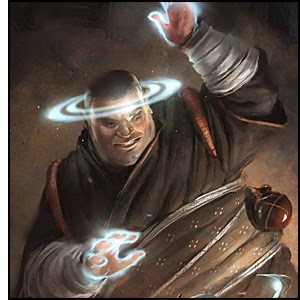
It seems like issue #389 may be a different story, though, as we start the month with a great article for the Monk class, signed by Peter Schaefer. Subtitled "Fallen Needle Itinerants", the article features some amusing backstory on a monk master called Fat Aloisus, as well as really inspired mechanics. I already talked about my love for monks when we got to see one half of the class and, after reading the rest, I think they are easily the best thing to come out of Player’s Handbook 3, and one of the coolest strikers in the whole game. However, there is one thing that PHB3 didn’t get completely right but this article redeems: the use of Full Disciplines.

Don't let him deceive you, it's all muscle. Really.

For those not versed in the Way of the Monk, a full discipline is a special kind of attack that actually includes two powers in one: an attack technique, and a movement technique. The attack technique is pretty much your standard 4E attack power, but the other one is the cool part - a special mode of movement that can only be used on the same round you use the associated attack, typically granting effects such as increased movement speed or shifting, but also jumps, teleports, switches, and other tricks that you’d expect from utility powers.

The Full Discipline mechanic shows a lot of potential, as both parts of a power can be tied thematically or mechanically, having special synergies with one another and even resulting in powers with sub-standard attacks that are nevertheless worth taking due to a strong movement effect. Unfortunately, we didn’t get to see too much of this in PHB3 - but this short article makes up for it in spades.

The greatest innovation of the new powers in this Class Acts (one At-Will and six Encounters) lies in breaking an unwritten rule of Movement Techniques: that they have to cost a Move Action. By using triggered free and immediate actions, and even minor actions, these disciplines add even more variety and dynamism to your monk, and can result in great frustration for monsters trying to engage in melee.

This kind of powers can be a little confusing, in that many players tended to assume that you could only activate a movement technique in the same round as the corresponding attack technique. However, looking closely at the rules text, we find that the limitation is actually to use them in the same round, so it’s perfectly possible to use the reaction moves as long as you made an appropriate attack during your turn. Also, you should be aware that the rules only prevent you from using different full disciplines, but nothing stops you from spending your standard action on a different kind of attack (like basic attacks or multiclass powers) and choosing any of your at-will movement techniques. This should prove particularly useful for hybrid characters.

Anyway, I hope we can see more DDI material of this quality in the future. Now I just need to get my hands on a monk PC, to try out the new stuff...
Read More......