Showing posts with label DDI. Show all posts

Wednesday, October 12, 2011

Class Acts: Assassin–Secrets of the Ninja

We don’t get a lot of exciting player content in Dragon magazine these days, but today’s article made me extremely happy. Written by Dave Chalker, of Critical Hits fame, the article offers an awesome new Executioner build: the Ninja. There are just 2 pages of mechanical content, including six powers, two magic items, and a new superior weapon, but they really get the job done. Ninjas get a Shuriken Barrage attack (which reminds me of a fixed Hand of Radiance), a Smoke Bomb, an short sword attack that rewards them for jumping around randomly, and a vicious double attack with their Kusari-gama – which is a weird, but effective weapon, by the way. On top of that, one of the magic items is a rare Ki Focus with an impressive set of abilities, easily among the best rare items I have seen to date.

I need to play this build. So far, the Executioner had been a class that I admired for its original design, but which didn’t quite convince me to try it out. These new options, along with the ability to use assassin’s shroud (from the Hybrid and Multiclass article), have finally tempted me.

Read More......

Tuesday, May 17, 2011

Class Compendium: Cleric. Goodbye, controller powers.

If it isn’t broken, don’t fix it. Or should you? The latest installment of the Class Compendium series (available for free here) reprints the cleric class with a new format, incorporating all previous errata. However, unlike similar articles for Fighters and Warlords, this time the update comes with a good deal of brand new errata which definitely goes beyond mere clarifications. To say most of these changes were unexpected would be quite an understatement.

One thing that has to be understood about the cleric is that, while fairly competent, it is by no means a powerhouse of a class. It had its brief time in the sun somewhere after the release of Divine Power, where healing bonus stacking got to the point that you could outheal one or two monsters’ worth of damage at no surge cost, just with your at-wills - whereas parties could become nigh unkillable in any encounter where a daily prayer was involved. Thankfully, this was put to stop through an errata that brought drastic cuts to most common methods used to boost healing, particularly of the non-surge-required variety.

After that update, clerics were left as very strong healers (probably the best in the game, at least regarding single-target heal output), but became otherwise unremarkable leaders, noticeably behind all-stars like the Warlord. So what are we to think, when Warlords go through their Class Compendium revision mostly intact, yet Clerics get weakened significantly? Have the developers gone crazy? That may be the case but, as we will see, there is a method in this madness...

Here is a summary of the updates, classified by what got changed:

Area attacks with reduced area/damage/friendliness
Turn Undead (feature), Flame Strike (Daily 9), Holy Spark (Daily 15), Pufifying Fire (Daily 15), Seal of Warding (Daily 15), Enthrall (Encounter 17), Fire Storm (Daily 19), Healing Torch (Encounter 23), Sacred Word (Daily 25), Astral Storm (Daily 29), Astral Wave (Paragon Path Encounter 11), Healing Sun (Paragon Path Utility 12), Radiant Brilliance (Paragon Path Daily 20), Battle Pyres (Paragon Path Daily 20).

Options switched to Strength/Weapon
Holy Wrath (Daily 19), Seal of Protection (Daily 25), Angelic Avenger (Paragon Path), Warpriest (Paragon Path)

Clarification
- Spiritual Weapon (Daily 5) , Astral Refuge (Utility 10), Thunderous Word (Encounter 17), Clarion Call of the Astral Sea (Utility 22), Angel Ascendant (Paragon Path Utility)

Other
- Consecrated Ground (Daily 5) - removed area mobility.
- Nimbus of Doom (Daily 25) - added miss damage.
- Radiant Servant (Paragon Path) - crit-boosting feature now requires cleric powers. - Warpriest (Paragon Path) - renamed to Tactical Warpriest to prevent confusion with the Warpriest.
- Warpriest (Paragon Path) - marking feature toned down, now works 1/encounter.


So we see a couple of trends here. Apart from a few clarifications and a handful of random changes, there are two major update categories: improving support for the Strength Cleric build, and nerfing the Nine Hells out of the cleric’s area damage capabilities. The Strength Cleric thing is not earthshaking by any means, but it does mean that all strength-based attacks are now weapon based (which is a good thing, since requiring an implement made these powers virtually useless), and that there are two very solid paragon path options for the build, where there previously was almost none (one of the weakest points of the build, by far). This is still one of the least supported builds in the game, but going over the book, I could see that it now gets two solid choices at almost every level, and as much as we’d all want some more, I’d say the build is now in a decent shape.

As for the fact that virtually every cleric area attack in the PHB has gotten worse... well, I really didn’t see that one coming. Yet, in hindsight, it does make sense, in a way. Let me begin by pointing out that this in no way answers any game balance issue: The revised powers didn’t make the cleric any stronger than (or, some will argue, even as strong as) other leaders. Or characters of other roles, for that matter. On the other hand, I don’t think this creates a game balance issue, either - the cleric still has a lot of cool stuff going on, and is wholly capable of performing its role in a capable, if not spectacular way. More important, though, is the fact that the revised powers are still playable, and in some cases pretty good.


No, really. Look at them. It’s easy to come to the conclusion that, if something that wasn’t game breaking gets weaker, it surely has to become worthless. And, although that is often the case, I don’t think it is what has happened here. When I read the new power list without looking at the old versions, nothing stands out to me as particularly weak (or, at least, none of the powers that actually got changed), because the new values really reflect the current standard for the game. And even with the smaller, less damaging, and more unwieldy areas, clerics still have some impressive controller abilities. On the other hand, even if the update isn’t disastrous, that doesn’t mean it was justified. Why change things for change’s sake? I think that the main reason behind this is the fact that the cleric stepped a bit too much on the toes of real controllers. I mean, there are few, if any, area attacks hitting as hard as pre-nerf Astral Storm in the game, and Sacred Word was one of the most brutal ways to stun the opposing team, particularly after other classic options, like the wizards’s Legion’s Hold had got their own errata. This is not to say that every revised power was problematic, but as a whole, this collection of area attacks had little to envy that of a Wizard, and in some cases could make other controllers cry with envy. So this may be an attempt at drawing a line for what kind of controlling effects should be available for controllers and non-controllers. And we still only know half the story. The Compendium version of the wizard still has to come out, and I wouldn’t be surprised to see some powerhouses that are currently considered benchmarks for area damage, like Flaming Sphere or Stinking Cloud getting their own, well deserved revisions.


Overall, I think this isn’t as big a deal as one would think by looking at the long list of affected powers. If you enjoyed playing a cleric before, your character will still play just fine. Oddly enough, the characters suffering the most from this update won’t be clerics: Warpriest (or should I say, Tactical Warpriest) was the paragon path of choice for many defenders or defender wannabes, but didn’t fit as easily in cleric archetypes - and while the new version is still strong enough, players who relied too much in its defender mark will suffer. But it’s hard to shake the feeling that this is all downside for cleric players, who won’t see much relief in the thought that class roles in the game become slightly better defined because of this. I mean, the update is good news for Strength Clerics, but otherwise most clerics don’t get much to compensate for the loss, and with the current rate of content release, are unlikely to do so in the foreseeable future.

Oh, well. I’m glad that Consecrated Ground got the axe. But I still don’t understand how they missed Divine Oracle.
Read More......

Wednesday, March 30, 2011

Class Compendium: Warlord. New format and flavor, same mechanics.

The first chapter of Class Compendium has come out today, barely making it into this month’s issue of Dragon magazine. I am mildly disappointed, not for any lack of quality in the material itself, but because I half expected it to have more ambitious goals. The article consists on a reprinting of the Warlord class, as originally seen on the first Player’s Handbook, but reformatted to match the new style introduced in the Essentials books, and incorporating all existing errata, and a lot of clarifications. The number of functional changes has been kept to a minimum, though, and this is the point where I have been let down.

To be fair, even without mechanical changes of note (apart from a much needed rewriting of Commander’s Strike for clarity purposes, and the redesign of a couple of daily powers), the article holds more value than I had imagined. The Essentials format takes up a lot of space, but it does read much better than the dreaded Walls of Powers in the original 4E books. There is quite a lot of added flavor, which some will consider filler, but at the very least is quality, well written filler. And although the effects of most powers remain unchanged, their text has been extensively revised and polished, becoming much more clear and formal. Putting my old PHB next to this article, it is now evident how rough the writing of power description was in the early 4E days, so this is definitely an improvement. Also, even though the Warlord has suffered relatively little errata, it is nice to have a reference text where you know that everything is up to date - previously, we had to resort to the online Compendium, which is handy, but a bit cumbersome if you intend to read the whole class.

Now, the only question remaining is, was the Warlord unchanged because it’s the overall policy of the book, or because the class is that good? The answer is relevant because some of the other classes and builds compiled in Class Compendium are in greater need of functional updates, such as the Wizard (which should see its encounter powers overhauled to match the miss effects introduced in Heroes of the Fallen Lands), and the much maligned Strength Cleric (which suffers from a remarkable lack of options). And here, I must admit that Warlords were in pretty good shape, to begin with. There are very few things that really stand out as wrong (including the Battle Captain paragon path), and a couple of lesser updates that I’d like to see but are far from vital (such as changing Knight’s Move and similar utilities from ranged to close burst powers). So it is perfectly possible that other classes will see more changes, because they deserve them more. We will see...

By the way, it is probably a mistake that will get fixed at some point, but at the time of writing this, this article can be freely downloaded, despite the fact that is marked as subscriber content. My guess is that the intention was for the actual errata (which is compiled as a separate sheet) to be offered for free, while the article itself remained behind the paywall. At any rate, if you are not a DDI subscriber, you could do worse than downloading it and checking it out, while there is time.
Read More......

Wednesday, March 23, 2011

Adventure Tools updated, now with 100% less Monster Builder!

Those who have been following this blog for a while know that my attitude toward the D&D Insider service errs towards a cautious optimism. Today's news, however, offer me no bright side to look upon. A new version of the Monster Builder has been released, completely devoid of the most basic elements you would expect in such a tool - notably, the ability to Build Monsters. Thus, for the first time ever, I have sent Wizards of the Coast an Angry Letter (tm), which I reproduce here for your enjoyment and shared indignation.

To: Wizards of the Coast customer service
Re: Missing feature (Monster Building)

The newly released online tool for DDI has been wrongly announced as a Monster Builder. This is an unfortunate mistake, since its monster building capabilities are almost nil. The removal of this essential feature would have been a serious letdown to me, had it been properly communicated. However, there has been no official word on the matter, and I have only found out when browsing the tool, by clicking hopelessly in search of the most basic functionality. This makes things so much worse.

This is not a product ready for public release. I have been following its progress since the beta, and I can see the polishing effort that has taken place since then. However, its current feature set provides no value at all to me, being little more than an alternate interface for information that I could already access from the Compendium. I was excited to see this tool, because it didn't cross my mind that it would be released without editing functions.

I honestly wonder what led you to think this could be a good idea. If editing features are to be added at some point in the future, you should have waited until they were ready. If they are not, I guess this still has value exclusively as a component for the virtual table - so you should have released it whenever the VT came out. The importing feature could have been a redeeming point, if not for the fact that the original Monster Builder has been bugged into almost uselessness for months now, so I am unable to generate non-corrupt monster files. The only thing this tool has managed to do is annoy me.

Please, don't do this again. I can take delays and cancellations, and even a certain amount of bugs and instability on a release, but trying to pass off some hollow piece of software as the real deal is utterly pointless, and a waste of your time, as well as mine.

Edit (23/03/11): The following comment has been posted by WoTC_Trevor on the official forums, addressing many of the concerns expressed above. I'm not sold on their arguments, and it comes a bit late, but it's certainly better than nothing.

Now on to the topic of "why did you release something that wasn't feature complete?" questions/complaints. Main reasons, short and sweet - we wanted to give all the DDI members a chance to check out what we're working on, and we wanted to make sure that all DDI members had the chance to use the MB to import monsters into their VT games during the next step of the VT beta.

You still have access to the classic MB (you can download it right now). We won't be doing any more updates to it, but it's still there and still usable. Yes it has issues, but I'm hopefully most people understand that we won't be working on the old tools while adding features to the new tool. With the web-based MB, we have something that gives very basic functionality and is usable with the VT that we wanted to get into everybody hands, not just the small group of testers that we had before.

The VT point is a bit more tangible - Having the web-based MB out, even in this limited form, makes imputing monsters into the VT 1000% (statistic completely made up) better for DMs. So getting this out to DDI subscribers who will very soon be testing out the VT seemed a pretty important thing.

I am definitely sorry that I haven't given you more news on what to expect with this AT release these last few weeks. I'm also sorry if I led you to believe that the AT would be more robust than what the closed beta testers had access to. We did add a couple features, but the biggest changes are on their way. I will be back in the coming days with more information on the features we'll be implementing, focusing on whatever the next big thing is.


So at least we can expect the current state of affairs to be temporary - editing will be added, eventually.

Also, although I haven't seen it documented anywhere, there IS an upside to the latest update, as they have introduced a very cool feature that I could actually enjoy using. The Monster (sigh) Builder now has the ability to display pictures for each monster in the catalog. Currently, only a very limited selection of monsters features any art (try looking at Monster Vault or Monster Manual I creatures, for example), but they intend to add it for all of them.


The idea of having art in the MB was definitely a good one and we want to do that as well. For now we've implemented a lot of the art that was in the Monster Vault along with some additions, and we definitely want to get more art in there. I personally would love to have some contests for people to submit some art for those creatures that don't have any, and then use the winners as our official pieces of art in the MB. We'll see how things work out as we get more features/content.

Read More......

Wednesday, March 2, 2011

Class Compendium in this month’s Dragon

When half of the scheduled books for 2011 got cancelled, we were told that the material in them would be released in ‘other ways’. The logical solution seemed to be converting them into DDI articles, though it was not clear how long it would take for them to see the light this way. It turns out, not too long - in this very issue of Dragon magazine, we’ll get to see the first sample of this material, in Class Compendium: Warlord.

Quick recap: Class Compendium, Heroes of Sword and Spell was a book originally scheduled for february, 2011, intended to reprint part of the class material from the original Player’s Handbook. Specifically, it would include the main four D&D classes (Fighter, Rogue, Wizard, Cleric), plus the Warlord. These wouldn’t be new builds, but the PHB material reformatted to match the current Essentials style, and including all published errata. Also, I was half expecting that they introduced new errata with this book because, honestly, it was too good an opportunity to pass up on: at the very least, they should update wizard spells to include magic school keywords and miss effects on encounters. But there was also lots of clarification and minor rebalancing (Sure Strike anyone?) they could make without much effort. On the other hand, this would tread into ‘4.5 edition’ issues (by reprinting and invalidating previous material) more than any previous book, including the Essentials line, so perhaps it wouldn’t be such a good idea.

Anyway, whatever was going to be in the book, we are getting the first chapter at some point in march. The article description suggests it will include ‘the most current updates to many powers, features, and feats’, which doesn’t seem to imply there will be any new updates, other than the ones already seen in previous errata. I’d much rather see them adding new fixes, as the article would feel like a waste of space to me, otherwise. I mean, there is some merit in releasing a book that merely changes the format and adds minor corrections to existing stuff, because it’s a physical product that new players can buy instead of the much errataed PHB. But on DDI? Subscribers already have access to errata pdfs, updated class descriptions in the online compendium, and up-to-date character builder - so these compilations won’t add much value to them, unless they bring some actual changes. We will have to wait and see.

To conclude, I’d also like to point out another article in this month’s magazines which, while not horribly innovative, is going to address something many players have been asking for ever since Heroes of the Fallen Lands was released: alternate ability score bonuses for all races that still haven’t got one. This is a simple, yet extremely useful idea, and I’m glad they are finally doing it. And it looks like it will be open to all readers (rather than just DDI subscribers), to boot!
Read More......

Sunday, February 20, 2011

Hierophant Druids: The Elemental Power Source is among us!

This week in Dragon magazine has seen the release of Class Acts: Hierophant Druids, yet another piece by Rob J. Scwhalb which, while solid enough (as all things Schwalb) would not be particularly remarkable on its own merits: it features some really nice and original flavor, but I found the mechanics that support it to be rather mediocre. That is, except for the little fact that they introduce a new power source to the game...

Unless I'm missing some obscure paragon path out there, the three powers featured in this article are the only ones in the game with the Elemental keyword - and I don't even know if there's any specific name for spells of the elemental power source (like divine powers are called prayers, and martial ones are exploits). And two of them aren't even fully elemental, but a combination of elemental and primal. So it's not like we can figure out the contents of an upcoming Elemental Power book from that (or rather, Heroes of the Elemental Chaos, if we follow the most recent naming pattern).

But there are some things we can tell about elemental, even from this tiny sample. The mere fact that they haven't dismissed the idea altogether, and that they are willing to release material related to it is encouraging - we didn't get to see anything labeled as 'ki' before that power source got axed, after all. We won't see any elemental-themed class in print this year, though - that much we can tell from the current release schedule (something about which I should write one of these days, by the way), which has Heroes of Shadow and Heroes of the Feywild as the only player-oriented releases for 2011. But, as I speculated above, it does look like a sign that we should expect a similar product inspired by the Elemental Chaos somewhere around 2012.

What can elemental offer, as a power source? I am a bit torn about it... on the one hand, I find the whole element concept pretty cool, and there is a lot that can be done with the four classic elements. Also, I just love how it all fits in the 4E cosmology, as the primordials are engaging villains, and the Elemental Chaos is a much more interesting place to visit than the plain old monochromatic, single-element planes found in the old Great Wheel. But is that enough to support cool new character concepts?

This is the greatest strike against an elemental power source, for me. I really can't think of a fantasy archetype that would make for a great elemental class. Sure, we have had our share of placeholder role/power source combinations in 4E, like Invokers and Wardens, which felt a bit too forced at first. But at least we had clerics and druids as strong pillars to base their respective power sources. Is there any concept out there that could fill that gap for elemental? Like the wizard is to arcane, or the fighter to martial?

It's not that the four elements lack design space - in fact, the opposite is true. But they have already seen so much use in other power sources, that maybe there's not a clear niche left. Arcane has always been strongly related to the idea of huge explosions of fire, ice, lightning and whatever it is that earth does these days. I am of the opinion that you can't do anything with fire that's cooler than the good old fireball, anyways. And primal magic also makes good use of the elements, usually spicing them up with some animal themes. Hell, even divine characters get to have some elemental fun every other day, particularly of the lightnign and thunderstorm variety. And any of them can choose to focus on a single element, or just use any number of them, so our fledging elemental class can't even hold to that.

The solution we have seen in the powers from the Hierophant Druid article (all three of them) is to introduce powers that use all four elements at once. Or, rather, a choice of one of the four each time you cast them. The implementation in this article isn't particularly brilliant, and I'm afraid the basic idea is flawed: you are just spreading the power too thin. It's difficult enough to come up with a power effect that is original, fun, and balanced - designing something with four variations that fill these criteria, and are somehow related but different enough from each other is a painful task. And it's not even particularly rewarding! I guess the added flexibility is welcome, and at least you can tell it's a different power source because nobody tried the four-elements-in-one shtick before, but what is the point? I honestly think any of these powers would be better off if they had focused on one, or maybe two of the elements.

So, what else could they do? I think that having powers that combine two or more elements in one single effect (rather than presenting a bunch of bland options) could have some potential. It's the same idea that led to the creation of hybrid elemental monsters in Monster Manual I: it still feels elemental, but opens up a ton of possibilities. Sure, single-element monsters (or, in this case, powers) feel more iconic, but they have also been done to death by now. I still don't see how this could be used as the basis for three or four classes, but it's better than nothing...
Read More......

Monday, February 14, 2011

Bards of Wolfstone

With Dragon magazine content growing more and more scarce in the last months, I don’t get much in the way of great articles to review. Thankfully, this month has brought us a small gem, in the form of a class article for melee bards called Bards of Wolfstone. Signed (like so much DDI material) by Robert Schwalb, the article is short (four new powers, three feats, and a couple pages of backstory), but makes up for it with a combination of polished mechanics and imaginative ideas.

Rules-wise, this article is remarkable in its lack of filler items. Granted, it would seem like this is an easy accomplishment when you are only delivering a handful of feats and powers, but I had grown accustomed to rates of 50% or higher subpar or unplayable items, regardless of article size. Here, there is only one skill-centric feat I’d be inclined to dismiss, and even that one provides enough utility so as to be useful in games where Intimidate checks are relevant.

We get four new encounter attacks for melee, weapon-using bards, distributed across all tiers. They all share the peculiarity of counting as both primal and arcane attacks (since an affinity for primal magic is the defining characteristic of the Wolfstone Bards referenced in the title), but are otherwise conventional bard powers. The mere fact that they are playable melee weapon attacks is good enough news for many bard players, as the range of options for melee builds of the class was pretty slim. Mechanically, these powers are based on the creation of zones that last for a turn, boosting you and your allies or punishing enemies that end their turns there. The fact that these zones work regardless of the attacks hit or not makes the powers particularly attractive.

Rounding up the article are three new feats available to bards of any build. My favourite is Battle Cadence, which boosts the sliding effect of your Majestic Word while providing a small damage bonus. Wild Virtue is also rather nice, as it grants free movement when your bardic virtue is triggered. Finally, Words of Wrath is the least impressive of the three, as it affects intimidate checks - but, that said, it has a strong effect if you do use that skill.

As for the article flavor, it has a clearly nordic inspiration, with bards leading barbaric tribes against frost giants and similar creatures on frozen regions. Interestingly, it follows up on a previous Dragon article (the also excellent Humans of the Wild, from Dragon 386) which introduced the community of Wolfstone. This is a rare case of continuity between Dragon issues, and I’d like to see more like it. There is even some mechanical continuity at work here, as the article cites yet another previous source (Class Acts: Bard. in Dragon 376) as including an ideal paragon path for this particular breed of bards. Of course, the fact that Mr. Schwalb is the author behind all these articles doesn’t hurt, and less prolific writers would have a harder time trying to pull this off.
Read More......

Wednesday, January 26, 2011

Online Monster Builder, integrated DDI tools.

The D&D Insider service has seen better times. During the last months, subscribers have suffered a slow, but noticeable decline in magazine content (particularly when it comes to new options for players), a Monster Builder plagued by annoying bugs, an awkward transition of Character Builder to an online model (which many people perceive as a downgrade), and many delayed updates. The good news, such as the announcement of the beta for the Virtual Table(or rather, the confirmation that the VT would actually exist!) and the promise of a tighter development process for magazine content, were hardly enough compensation, and we couldn’t help but feeling that the service just wasn’t as satisfying as a year ago. The latest announcement from Wizards of the Coast may be the first step towards correcting this trend.

The long promised online Monster Builder is ready to enter beta this week, which should be great news for those who had been struggling with its buggy offline incarnation. As with the Character Builder, the move to an online model means that the tool is no longer usable if you let your DDI subscription expire, but the fact that the offline MB hasn’t been working all that well for a long time means that this time the change has a clear advantage for current customers. It could be argued that the most annoying bugs, which weren’t present when the tool originally launched, should have been more than fixed by now, but at least this is a solution.

Anyway, the bit that has got me excited is a different one. In the following days, the Virtual Table beta is going to incorporate new functionality, as they will enable the connectivity with Character Builder and Monster Builder. I think this is a great improvement, and the first tangible benefit we get from having online tools. The VT beta has been going for a couple of months, now, and I even received an invitation a while ago. I tried it out, and found that it was a solid piece of software, with a nice user interface and most of the features I needed (keeping in mind that I have no real interest in playing online sessions, but was intrigued by its potential as an aid for my tabletop games) except for one crucial point: creating characters and monsters was a pain. Integration with the remaining DDI tools was the logic solution, but not only was it missing from the beta: it wasn’t even mentioned for future plans. So it is a relief to know that they had actually though of this and that it is, in fact, almost done now.

So it seems like we aren’t too far off from a fully functional Virtual Table and Monster Builder. If we add to that the dozens of Character Builder bugs that have been addressed in the latest update, we are approaching a point where the DDI tools can have most of the functionality that was offered a year ago, and add some really cool stuff on top of that. Now they just need to put some actual content in Dragon magazine...
Read More......

Friday, January 14, 2011

2011 Cancelled products, DDI news

The last week has been an interesting one, for D&D-related news. Fans had been worrying for a while about the mysterious disappearance of several books from the official 2011 product catalog, which was followed by their removal from online shops such as Amazon. Not only that, but the recently adopted changes in the D&D insider content schedule (moving away from a fixed content calendar to a fairly anarchic scheme where a list of articles was announced at the beginning of each week without specifying what got released each day) were resulting in several days in a row with no content whatsoever. Several fans complained about this state of things, as well as the lack of communication from the company... until, finally, this wednesday we got some official answers. And man, when it rains, it pours.

There is a lot of stuff going on right now, so I’ll try to give a brief summary: half of the D&D book releases for this year have been cancelled, Dragon and Dungeon magazines will have delays in the short future due to improvements in the editing process, monthly compilations for these magazines will no longer be provided, and DDI will provide weekly columns starting next week. There are reasons to be concerned, but also a few glimmers of hope (or, dare I say, points of light!).

Let’s start with the killed books. This is a harsh blow, particularly since the 2011 release schedule was pretty sparse, to begin with. Of the six books that had been announced, only three will make the cut. Heroes of Shadow, the only one with material for players, is delayed until april due to a change in format from Essential-like softcover to a more traditional hardcover. The remaining two are rather exciting DM resources: the Shadowfell boxed set and a new Monster Vault. The cancelled titles are a more strange lot, though. The Class Compendium was to be released next month, making this sudden change all the more surprising, but it was always a controverted book, and probably not an easy sell - consisting on a reprint (with Essentials-style format) of five classes from Player’s Handbook, plus some extras such as feats, rituals, and rules for better integration of Essentials and classic builds. Then there was Mordenkainen’s Magnificent Emporium (aka Adventurer’s Vault 3), which is the book I will miss the most. It was suppossed to include enough flavor and description to actually make a readable magic item book... but also to provide some much needed Common and Rare items to use with the new reward rules. Finally, we had Hero Builder’s Handbook, originally due out this summer, which had a hazy description regarding non-combat related options for player characters. I was never sure what to make of this one, but Character Themes (à la Dark Sun) had been mentioned, which would have been a nice thing to see.

The changes to digital content production are a mixed blessing. On the one hand, putting up with weeks of content delays is an annoyance... but the upside is encouraging. As explained by magazine editor Steve Winter, from now on all digital content will go through the same development process as printed products. How is this different from the previous system? Up to now, both Dragon and Dungeon were reviewed by the game R&D team, which did a fairly good job but still left a good deal of bugs and typos. These were more often than not corrected in the monthly compilations, though. With the new methodology, the reviewing effort increases, and there are more people involved, so we should see a noticeable improvement in quality. Moreover, there’s talk of harmonizing this content with R&D’s long range plans for the game, which is an interesting prospect. One of the downsides of DDI articles has always been their random nature: the published articles depended on whatever got submitted and the preferences of the editor, but this led to an irregular growth of the game. As an example, some popular options, like fighters and wizards, ended up with a ton of content, but others (say, Seekers or Changelings) got left behind.

This brings me to some interesting speculation. In an official FAQ regarding the product changes, we find this explanation for the cancelled books:

We are constantly striving to remain conscious of the way our fans consume our content. We felt that the material in these titles would best be presented in other ways and we have plans to make it available in the future.

So, if future Dungeon and Dragon issues are to include R&D-sanctioned content, and the cancelled books will be presented in ‘other ways’, it’s not a huge logic leap to get to the conclusion that material from these books is likely to get salvaged for DDI. There is only one hole in this story: if they are doing this, why aren’t they telling us? Right now, these cancellations are only seen in a negative light - D&D content for this year is being kept to a minimum. If the books were going digital rather than disappearing altogether, the sensible thing would be to announce it, loud and clear! So either they are saving the announcement for a specific time (perhaps the Dungeons & Dragons Experience, at the end of this month?, or we are missing something important, or their strategy makes little sense.

Speaking of absurd strategies, the end-of-month compilations for Dungeon and Dragon magazines have come to an end. From now on, digital articles will have to be read separately, which is fine for regular readers, but not so much for those catching up after a time away. The official line mentions lack of user interest as the main reason, but that looks like a poor excuse. Very conveniently, this change discourages users from subscribing to DDI for one month once or twice a year, and downloading a lot of content in one go, not unlike the recent changes to Character Builder and the announced new version of Monster Builder. The fan response to this change has been almost unanimously negative, and not without reason - this is a straight downgrade in service, with little in the way of compensation.

Thankfully, not everything is grim in the future of DDI. A major change to the D&D website (that will benefit non-paying users to boot) is the introduction of free weekly columns! The only surprising thing about this initiative is the fact that they hadn’t tried it before - after all, this is the same company that gave us the extremely successful columns in the website for Magic:The Gathering, including the absolutely awesome designer insights from Mark Rosewater. Column series will include “Legends & Lore”, a game theory piece from Mike Mearls (which I really look forward to reading), “The Dungeon Master Experience” by expert DM Chris Perkins, “Design & Development”, which gets upgraded to a weekly feature” and “Rule-of-Three”, which will be a Q&A series. There is also a fifth title to be determined. Honestly, this looks like great news.

So that’s it for now. I expect some kind of follow-up in the near future, if only because many of these changes don’t make much sense unless there is something else going on. Time will tell...
Read More......

Thursday, November 18, 2010

DDI Virtual Table goes Beta!

The last months haven' looked good for D&D Insider, what with the delayed updates for Dark Sun and the Essentials books, the release of the controversial new version of Character Builder, the Essential Assassin screwup, and a general feeling of decay in the quality of Dragon magazine content. In this context, it's only natural for fans to be skeptic when the developers promise new online features for an indefinite, but near future. Simply put, there was little faith that the software team had the resources required to put out a meaningful new tool when even routine upkeep was in a deficient state. Therefore, we were pretty surprised when the Virtual Table came out of the shadows and sneak attacked us to death!

This Virtual Table is clearly a Lurker, but of what level?

Yes, there will be a Virtual Gaming Table for DDI! And, from the look of it, it will not be mere vaporware this time (unlike the infamous tool promised for the initial DDI lineup, which never came to be). In fact, it is entering closed beta (meaning we won't get to play it for the time, just to read the impressions of people who do) as soon as this week! Clearly, the final version (perhaps even the open beta) is still months away, but just seeing that it is in such a functional state is an impressive feat.

What do we know about it?

A FAQ page has been provided with basic, but useful information about this new product. This is what called my attention:

Features
  • Editable Map (using Dungeon Tiles)
  • Movable tokens (using graphics from the ones in Essentials boxed sets)
  • Dice Roller
  • Character and monster information (NOT integrated with Character Builder or Monster Builder).
  • Initiative and condition Tracking
  • Text chat
  • Voice chat!
Missing Features
  • Rules enforcement
  • Integration with existing tools
  • (presumably) Support for line of sight, lightning conditions
  • 3D Graphics

Supported platforms: Windows PC and Mac. The application is web-based, uses Java (not Silverlight, like Character Builder!), and will require a constant internet connection.

Unanswered questions:
  • What will it take for me to access the closed beta? (Update: I still don't know, but it seems to involve filling this form)
  • Nothing has been said about pricing plans. Even if it doesn't increase the cost of a DDI subscription, it won't be of much use to players unless they allow multiple users per account.
  • No final release dates are known as of yet.
  • The initial version isn't integrated with the current DDI tools, but it really, really wants to. Nothing is said about future plans in this regard.
  • Will it support custom (i.e. non-Dungeon Tile) map elements?
  • No option for map export/sharing is mentioned. Having something like that, and perhaps preloaded maps for official adventures would be extremely cool.
  • No, really, can I join the beta now? Please?
Conclusion

After a number of failures in a row, this has the potential to be a big hit for digital D&D. I'll be keeping a close watch on this one, and post any news I find about it. One thing is for sure: the policy of not announcing things 'until it's done' has really worked, here. The Virtual Table gets the Surprise Round now - let's see what it can do with it.
Read More......

Essentials Assassin WTF?

I was halfway writing a post about the final version of the Essentials Assassin, and how it was a very odd mix of clever answers to player concerns (to the point that all my complaints about the class had actually been fixed!) and blatant screwup in very basic stuff (i.e. breaking the math so that the class no longer really works as an effective striker). The forums were raging all over the update, given how it neutered a class that had shown so much potential in its first draft. It was a strange story, but we have seen worse things come off DDI. Until now, that is.

A few hours ago, Steve Winter (editor for Dragon and Dungeon magazines) explained in the forums how the 'final version' released was, in fact, halfway through development due to a screwup in coordination between the magazine and R&D.

Yeah, it's D&D's version of 'my worg ate my homework'. It is silly and unprofessional. And it's also a remarkable display of sincerity (not that they had many other options at that point, but whatever). Now, I'm pretty sure that in no time we'll have plenty of conspirancy theorists speculating about WoTC inventing stories, or trying to fix the mess after seeing the forum reactions, or something like that. Honestly, I don't care.

The fact is, we had a great class in playtest that, for some obscure motive (likely involving sheer incompetence) was released in a broken form but, rather than staying that way, is going to get fixed in december. Sure, the designers and editors have lost a good deal of credit, but what I really care about at this point is that we'll get a properly implemented Executioner, eventually. And, all things considered, I'm confident that they'll get it right because they were so close this time. Honestly, as much as I liked the original, I really admired the many elegant solutions in this revision - up to the point where the math broke, that is.

Anyway, for those interested in playing the class as soon as possible (and one of the players in my campaing was considering the option), I had come up with a houserule that mostly filled the damage gap that was preventing this version of the Executioner to, um, Execute properly. It goes as follows.

At level 1, add the following feature:

Culling the weak: Your attacks against bloodied targets deal extra damage equal to your Charisma modifier.

This is a significant damage boost, but also a highly situational one, that happens to mesh well with the class theme and mechanics. If you play an executioner with this adjustment, be aware that your attacks against healthy enemies will be subpar - but if you coordinate with your party so that they leave wounded monsters to you, you should be bringing them down as well as could be expected from someone calling himself an Executioner.

Anyway, I'll be eagerly awaiting the December release. Let's hope it survives the editing goblins.
Read More......

Tuesday, November 2, 2010

Character Builder goes online!

Not everybody loves Dungeons&Dragons Insider, but it’s hard to deny that its Character Builder has been a roaring success. I know I have become an addict to quick, automated character generation, and I shudder at the thought of playing with hand-made sheets for anything other than level 1 games. With this in mind, the latest official announcement about the future of DDI tools will have far-reaching consequences for many fans: the days of Character Builder as a desktop application are over because, starting November 16th, it will receive a major facelift and become completely web-based.

The hard truth.

Regardless of other advantages of going online, I can think of a single real reason for this change: money. The business model of DDI had so far been extremely friendly (some could say exploitable) for consumers, as it was a theoretically subscription-based product that nevertheless left most of its components working even after you stopped playing. As an ex-subscriber, you kept access to all old Dungeon and Dragon magazines (provided you had saved the pdfs), and had a fully functional character editor. Only the Rules Compendium went away, but that is far from the most appealing element. Sure, you wouldn’t be getting the latest updates... but you’d always be able to get a 1-month subscription every 3 to 6 months (or even once a year, if you didn’t mind waiting) and keep mostly up to date for a fraction of the regular cost.

I am not arguing whether this was right or wrong - clearly, it was very convenient for players, but not so much for Wizards of the Coast. And it’s gone now.

What’s it like?

You can find the official announcement here, along with a bunch of screenshots and links to the FAQ. In essence, the Character Builder as we know it (and Monster Builder at a later date) will disappear, and in its place there will be a web application with pretty much the same functionality (minus the ability to work without an internet connection and a DDI subscription). The GUI has received an overhaul for the occasion, and it looks pretty good, so I’m hopeful that the user experience will improve. All character data will now be stored on the server, which will be a boon for those who, like me, have to keep track of characters generated in different places.

The technology it will be based on is Microsoft Silverlight, so you’ll be able to access it from Macs as well as Windows PCs. No details have been given about mobile phone compatibility, which might be possible on certain devices - but not on iPhones. There is no Linux support, either, though I’d be surprised if some kind of workaround didn’t exist for that.

The catch.

With what I have explained so far, there is plenty of material to keep flamewars all over the Internet busy for a good while. But there is one more detail that is likely to infuriate the skeptics, and it’s related with the content updates. The new Builder will go live on November 16th, and it will include material from all books released until October, including Heroes of the Fallen Lands and the much awaited Dark Sun Campaign Setting. Where is the deal, then? Simultaneously, support for the current, offline Character Builder will cease, so the desktop application will never get Essentials or Dark Sun. The only way to build characters from those books, other than by hand, will be by being a subscriber when the new service comes out. So forgetting about DDI and sticking to the old builder won’t be completely possible - I know of many people who won’t miss the Essential books, but Dark Sun has been extremely popular, and its absence will definitely be painful.

What now?

It will be interesting to see how the issue develops in the following months. DDI has now become an all-or-nothing proposition, as there is little point in doing short-term subscriptions anymore - either you intend to be a subscriber for as long as you play 4E, or DDI will hold little value for you. Clearly, there will be a lot of very angry people who will consider this as an act of war and won’t ever touch DDI again, but also a number of occasional subscribers who will choose to go full-time in order to enjoy the full package. I am not sure these numbers will favor Wizards of the Coast, but we also have to take into account whatever new players are brought to the game by the Essentials line. To them, there won’t be an aggravating precedent of an offline Builder, so perhaps they will be more receptive to the new tools.

As for myself, I have to say I renewed my subscription (for a full year) when it ran out last week, so I can’t say the change will affect my economy in the short term. I generally like the idea, as I think the new interface should be an improvement, and I see value in storing all my characters online. But we’ll see.

One last advice, though. Even if you are downright furious for this turn of events, and consider that Wizards of the Coast has somehow betrayed you, I think you should think hard about it, and see if you have the latest version of the good old, offline Character Builder. Because if you don’t, it will only be available for download until the 16th, and even if it lacks the very latest books, it’s still a damn good tool, and well worth a month’s subscription rate and bit of wounded pride.

An intriguing side-effect
As an aside, there is a very intriguing consequence of the shift to online tools, in that developers have commented on the potential use of data mining to identify problematic game elements. So, if too many or too few players choose a certain option, R&D will take notice and take it into account when releasing new content, presumably improving balance overall, and likely using it for marketing purposes. This shouldn't raise privacy concerns, though - according to them, they only get access to the raw data, but not the identity of the users generating it.
Read More......

Friday, September 17, 2010

Essential Assassin

"We’ve charted a new direction in class design with the Essentials products" - Bill Slavicsek, Essential Cleric preview.


The Executioner Assassin is new build (though it actually includes two sub-builds) for the assassin class, with a format inspired by the Essentials books, brand new mechanics, and a couple of twists in the resource system. Executioners are strikers that use both the shadow and the martial power source, making them the first build in the game with multiple power sources.

Ever since the first Essential previews, we have wondered what that "new direction" would mean for future classes. We will still have to wait for a complete answer, but it is easy to tell what it means for the assassin class: freedom. This is a build full of wacky design ideas, often breaking the (somewhat rigid) structure we have come to expect from a 4E class description, though keeping the underlying core intact. More or less, anyway.

The first thing that caught my eye about the assassin rules is that they are unexpectedly interesting to read. I love reading page after page of powers as much as the next guy, but even I have to admit that the original 4E format sometimes comes off a little dry. Following the new Essentials style, the Assassin has additional flavor text and descriptions for every feature and power, in just the right amount (a single paragrapth at a time) to spice things up without getting boring. Moderately extensive writeups for race-specific assassins, such as humans or drow, are also included.

The power progression feels familiar, yet special. You get at-will, encounter, daily and utility powers as with any other (non-Essential) class, though there are a few caveats. All of the non-utility powers are written so as to be build-specific, so that the Executioner can't benefit from previous assassin attacks, and vice versa. The at-wills available are different for each Executioner sub-build, and you can actually gain more as you level up. The daily powers keep their usual number and strength, but have been reflavored as special poisons which the assassin can craft and use each day. Also, they have been grouped by tier, so that at level 9 you can choose among three level 1 poisons, where previously you would have powers of level 1, 5 and 9. There is a slight mechanical change in that it looks like you'll be able to use multiple instances of the same poison each day, but other than that it is the same as traditional dailies, with a very cool flavor. And then, there is the encounter power.

This is where the assassin deviates the most from the norm, but I think it's more than worth it. Rather than choosing up to 3 different encounter powers, the executioner assassin has Assassin's Strike, a single encounter attack which improves as you level up. The trick is that Assassin's Strike deals roughly the same extra damage as the three encounters put together. In one fell swoop. This single, devastating attack really captures what an assassin is about, to me, and feels about right, power-wise. The loss in build and play options is somewhat compensated by the additional at-will slots, and the inevitable gap in power level (compared to classes that have 3 attacks with weird effects) is left to fill by class features.

And there are a LOT of class features. True to the Essential template, the assassin class has its own progression table for each tier, with new features spread out across levels. The partial switch to the martial power source is evident here, in that there is less emphasis in shadow illusions and teleporting (one of the cooler things about the old assassin), and more plain acrobatics and physical prowess. Features that let you land gracefully on a fall, or create clever disguises are examples of this mundane theme, though shadow magic becomes more prominent as you level up. This way, the paragon tier brings an extremely nice little feature with no combat implications but great story potential; called Shadow Coffin, it allows you to magically capture an enemy corpse, to hide your tracks or use it later as proof of death.

Oddly, for all the color and inventiveness that is present in other areas, the main striker feature is as bland as it gets: an extra d6 added to all weapon attacks. This is functional but boring, and would be a bit of a letdown if it wasn't complemented by one of the most awesome and flavorful offensive mechanics I have seen in quite a while: the Death Attack. Gained at level 3, Death Attack lets you automatically finish off enemies with less than 10 hit points (a threshold that increases as you level up) after you damage them. This seems quite potent, and fun, and more than justifies calling this build the Executioner - bloodied enemies will fall quite easily at your hands, and there is a potential for one-shotting enemies at lower levels that not even a barbarian would match.

The executioner also succeeds in an area where the previous assassin design felt lacking - the use of weapons. Both builds are proficient with ki focuses that allow an assassin to wield effectively any tool at hand. However, the original version of the class did little to incentivize the exotic weapons one usually associates with assassination, so the optimal style of play consisted in swinging brutish two-handed blades - not the most fortunate flavor match. The executioner fixes this by having weapon-specific attacks. A lot of them, in fact, and for many different weapons.

Each of the new assassin at-wills is associated with a specific weapon, such as the kukri, blowgun, or shuriken. These have long been (rightfully) regarded as crappy weapons, weak even when compared with the humble dagger. However, by having at-wills specifically tailored from them, the assassin can squeeze power out of them like no other class in the game.

For example, the kukri power lets you charge and deal 2[W] damage (at-will!), which after accounting for that weapon's terrible damage die ends up roughly equivalent to an attack with a heavy weapon such as a Mordenkrad. The blowgun attack deals miserable damage by itself but is more accurate than any other at-will in the game, making it great in combination with poisons, Assassin's Strike, or Death Strike. Or all of them thrown together - there is no such thing as overkill, for an assassin.

Also, if these specialized weapons and maneuvers fail, you're still free to make basic attacks with the heaviest stick you can find. Executioners are able to use their dexterity for basic attacks, swap weapons with ease, and switch from melee to ranged attacks without effort, so they should be able to have a much more eclectic fighting style.

And that's about it. As with other Essential classes, there are no class-specific feats in the article, though I'd be surprised if the generous array of feats for the classic assassin didn't hide several gems (without feature requirements) for the new build. The class is presented as a Beta version, so that playtest feedback can be sent before the final version is compiled in November. Nevertheless, my initial impression is that, barring a couple of typos and the odd table, the class is highly polished - more so, perhaps, than the previous assassin. The power level looks well adjusted, the mechanics appear to be quite fun, and the whole package is full of personality and flavor. The class framework is definitely unorthodox, but isn't really all that far off your regular 4E striker, in its core. I don't know if I'll have the chance to play with the class anytime soon, as my turn to DM our campaign comes closer, but I'd definitely recommend it.
Read More......

Friday, July 2, 2010

Class Acts: Monk - Pushing the boundaries of Full Disciplines.

UPDATE: Darn, the errata bugbear hit this article hard! It turns out that movement techniques with immediate actions were deemed too confusing, after all, as they all got changed to minor action shifts in the compilation. Good news is, minor action movement techniques are still there, and the article is still full of awesome.

I haven’t been writing much about Dragon Magazine lately, due to the overall mediocrity of last month’s content. Only two of the articles in June's issue (#388) were of interest to me: an intriguing Winning Races for Dragonborn, featuring an alternate encounter power for the race (which you can take without any kind of feat cost, an idea I fully support, and which I’d like to see more of), and a Class Acts dedicated to fire Wizards that introduced some cool ideas, but irregular mechanics.

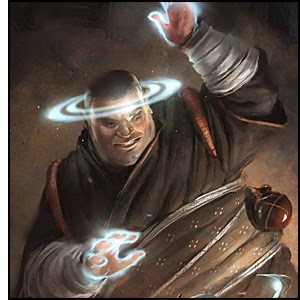
It seems like issue #389 may be a different story, though, as we start the month with a great article for the Monk class, signed by Peter Schaefer. Subtitled "Fallen Needle Itinerants", the article features some amusing backstory on a monk master called Fat Aloisus, as well as really inspired mechanics. I already talked about my love for monks when we got to see one half of the class and, after reading the rest, I think they are easily the best thing to come out of Player’s Handbook 3, and one of the coolest strikers in the whole game. However, there is one thing that PHB3 didn’t get completely right but this article redeems: the use of Full Disciplines.

Don't let him deceive you, it's all muscle. Really.

For those not versed in the Way of the Monk, a full discipline is a special kind of attack that actually includes two powers in one: an attack technique, and a movement technique. The attack technique is pretty much your standard 4E attack power, but the other one is the cool part - a special mode of movement that can only be used on the same round you use the associated attack, typically granting effects such as increased movement speed or shifting, but also jumps, teleports, switches, and other tricks that you’d expect from utility powers.

The Full Discipline mechanic shows a lot of potential, as both parts of a power can be tied thematically or mechanically, having special synergies with one another and even resulting in powers with sub-standard attacks that are nevertheless worth taking due to a strong movement effect. Unfortunately, we didn’t get to see too much of this in PHB3 - but this short article makes up for it in spades.

The greatest innovation of the new powers in this Class Acts (one At-Will and six Encounters) lies in breaking an unwritten rule of Movement Techniques: that they have to cost a Move Action. By using triggered free and immediate actions, and even minor actions, these disciplines add even more variety and dynamism to your monk, and can result in great frustration for monsters trying to engage in melee.

This kind of powers can be a little confusing, in that many players tended to assume that you could only activate a movement technique in the same round as the corresponding attack technique. However, looking closely at the rules text, we find that the limitation is actually to use them in the same round, so it’s perfectly possible to use the reaction moves as long as you made an appropriate attack during your turn. Also, you should be aware that the rules only prevent you from using different full disciplines, but nothing stops you from spending your standard action on a different kind of attack (like basic attacks or multiclass powers) and choosing any of your at-will movement techniques. This should prove particularly useful for hybrid characters.

Anyway, I hope we can see more DDI material of this quality in the future. Now I just need to get my hands on a monk PC, to try out the new stuff...
Read More......

Saturday, May 22, 2010

Class Acts: Invoker. More feats than you can fit in a Burst 2.

One of the best articles in DDI so far this month has been the Class Acts dedicated to Invokers. It's one of those increasingly rare, mechanics focused articles, offering little in the way of backstory, but full of new options - the ones I'm always looking for. Signed by the prolific and reliable Robert J. Schwalb, this article consists purely of feats, of all tiers and colors. With a total of 34 invoker-specific feats, this is more than the whole Divine Power book added to the class in that regard, unless we count Domain feats. So the number of possible combinations and builds for the class has been greatly expanded - opening up some very intriguing concepts.


Dubious Manifestation is a new feat of dubious quality for Drow Invokers

There's something I should get out of the way first, though. A dozen of these are racial feats- not a bad thing per se, as it actually covers the races that had been left out in previous supplements. And they are terrible. Not all of them are strictly unplayable (though many are), but they manage to be consistently bland, situational, and often pointless. The formula of 'gain a small bonus when you use your racial power' is abused to death, and almost always disappoints. It's not that it's impossible to make exciting feats with one-shot encounter effects, but they aren't even trying too hard - combat advantage, forced movement, small amounts of damage or even a +1 bonus to a single attack roll are far too weak benefits to be worth the effort.

The few racial feats that do something different are way more acceptable, though not spectacular: the changeling one, Flexible Covenant, allows you to change covenants each day, and the shifter feat Mobile Covenant lets you shift huge distances as your covenant benefit. Nevertheless, the racial stuff feels like mere filler, overall.

After that, things get more interesting. Way more interesting. The remaining feats develop certain themes, such as improvement of summons, specialization in ranged attacks, mastering the staff implement and granting covenant-specific benefits.

Of these, perhaps the most interesting are the ones thatenhance your summoningprayers. With a name like 'invoker', one would have expected a class with better support for powers that bring creatures to the battlefield, so there was quite a gap to fill. Thankfully, the feats are excellent:Carceri's Manacles slows enemies around summoned creatures, whereasRighteous Summons grants a different benefit depending on the character's covenant: attack penalties for maledictors, ally sliding for preservers and, my personal favourite, extra damage for wrathful invokers. To round it off, we have a general purpose feat that will greatly benefit summoners inHand of Fury, which grants extra attacks when a daily attack fully misses.

The feats that reward the use of ranged power are very intriguing because, unlike other controllers, invokers are very strong in this department (mostly because of *Hand of Radiance* and similar multi-target shots). Heaven's Arrow grants a bonus to hit against isolated targets - a condition that isn't usually that easy to meet, but which has quite a bit of synergy with the free slides from Covenant of preservation. Interestingly, it is a scaling feat bonus, as if tempting players to take the feat instead of Expertise. I don't think anyone will get that far, but it is something to consider. The remaining ranged feats are Angelic Harrier, which makes your dailies and encounters slide, and Vanguard's Eye, which grants protection against opportunity attacks.

Staff wielders will get to play a very different style of controller by taking Staff of Channeled Invocations, a feat that turns ranged powers into melee attacks. Among other cool combinations, this allows invokers of the Skill Domain to use Divine Bolts as opportunity attacks, in what may be the first realistic application of the power since it was mostly obsoleted by Hand of Radiance. The other staff feat, Pillar of Heaven, is also interesting but much more limited in scope, as it should only be useful to invokers relying on single-target ranged powers in their encounter slots.

As for the different Covenants, Malediction gets the most new options, with four feats. Of these, Crushing Doom looks particularly impressive, placing a significant damage penalty on all targets of your Maledictor's Doom power. The other covenants get three feats each, of which the paragon feats Preserver's Fury (target of Preserver's Rebuke becomes vulnerable to all damage) and Wrathful Outburst (Armor of Wrath targets an additional enemy) stand out the most.

Finally, the epic tier presents three generic feats that every Invoker should consider taking.Invoker Implement Expertise, as its name suggests, is the boring yet useful option to boost the crit range for all class powers.Dreadful Invocation is a truly spectacular feat that makes your critical hits from encounter or daily attacks inflict a lasting attack penalty, as well as forcing the target to move away from you (with the subsequent opportunity attacks). The last one, Reaching Invocation, works with area attacks, allowing you to target additional foes adjacent to the area - the Invoker's equivalent to Enlarge Spell, and a reason to maybe try Vanguard's Lightning over Hand of Radiance once you gain access to it.

To sum up, an amazing, useful and deep article. If you play an Invoker, chances are that you'll end up using several of the feats included here.
Read More......

Thursday, April 8, 2010

Class Acts: Warlock. Charisma for Infernal Pact?

This month, in Dragon magazine, Warlocks get another amazing article. No, really. Again. It definitely looks like someone at Wizards is badly in love with Warlocks. Of the tiefling variety. And is Lead Designer of the game, and thus allowed to do silly things, like using Charisma for Infernal Pact powers, and get away with it.

It's cool to be with the charismatic boys!

Yes, intrepid reader! The days where Star Pact Warlocks sat lonely as the one class build with weird stats have come to an end, as the Infernal Pact joins the club. Of course, the devil is in the details, because this time the designers have not forgotten to provide an alternate at-will for charismatic characters. This power, called Gift to Avernus, is a very nice clone of Eldritch Blast which features a shiny new mechanic from hell: taking damage to reroll an attack.

Let us take a close look at this mechanic, because it is shared by all the powers introduced in this article. The base idea is simple: when you miss, take damage and make a new attack roll. The question that most sensible Warlocks should be making by now is not 'why would I use a spell that hurts me', but 'how much damage, did you say?'. We're talking about practical people, after all.

The cost is equal to your level in HP. This is a real bargain at the very first level, but don't be fooled by that anomaly - it soon stabilizes into something closer to 10-15% of your total health. Depending on your tier, this may or may not be more than a round's worth of monster damage. That's quite a lot! This makes focusing on these powers a risky proposition, unless you are just not being attacked, or you somehow have a bunch of extra HP lying around. Enter Dark One's Blessing.

Isn't it an amazing coincidence that the infernal warlock's pact boon grans them exactly the temporary hit points they'd need to pay for a reroll with these powers? The existence of this feature drastically changes our evaluation of these powers, from something dangerous and probably not worthwhile, to a good outlet for the absurd amounts of THP you naturally gained, and usually wasted. If you ever feel that you won't have enough temporaries to consistently support this, just add Bloodied Boon...

With that out of the way, what do the powers look like? The at-will, in my opinion, is a very good proposition, leaving the reroll as an option, and granting full effect if you hit the second time. As for the encounter powers (one for each level), they are a bit trickier, since they actually force you to take the damage, and then only repeat the attack against a different enemy, and with reduced damage. Nevertheless, I think they are well worth the pain.

Reliability with damaging attacks is important for a striker, and most of these powers deal more than enough damage by themselves (in addition to granting extra chances for your curse damage). But it is probably even better when you are inflicting significant control effects. And we are also getting a good score in that regard! You have immobilizations, automatic self-attacks (triggering defender marks), enemies trapped in zones, sliding enemies in an area... most of them both interesting and strong. My personal favourite is a level 7 power called Pain to Pleasure, which heals you if you hit, then hurts you on a miss only to heal you again, if you hit the second time. Wicked!

The power selection is barely enough to support a Charisma-based infernal warlock throughout his career, provided he takes generic or off-pact dailies (since they are not included). This doesn't allow for much variety, but since every power presented is quite decent, if not actively good, you should be able to pull it off. Also, many of the new options are tempting enough to expect a Fey or Dark warlock occasionally picking one. And the at-will should become an instant classic among charismatic human warlocks.

To round off the package, we are also given two flavorful and very potent magic items for warlocks. The Rod of Avernus allows for mass sliding of cursed enemies when you use your Pact Boon, an effect that already has me salivating (and has earned a quick spot in some of my friends' wishlists). As for the Armor of Dark Majesty, it confers a huge defensive bonus against cursed enemies, which honestly looks overpowered to me. We'll have to see if it survives the compilation errata.

Speaking of errata, there is one major bug in the article's mechanics that, well bugs me. Using damage type - changing weapons, you could potentially turn the HP cost of rerolling the new powers into resistable damage, most notably fire damage for tieflings with fire weapons, allowing you to essentially ignore the drawback. This really should be addressed. Apart from that, the article is quite a good read and very useful in play, so I can't help but recommend it.
Read More......

Wednesday, March 24, 2010

All about Shields: A Fighter Class Acts article

Continuing with the ongoing trend of goodness in march DDI content, today's feature is a very niche article that happens to fit MY personal niche: that of Fighters with shields. The article, signed by Daniel Jones (who is getting D&D material published for the first, and hopefully not the last time), fills 5 pages with a wide assortment of options for the defensive-oriented warrior. This is good stuff, with many fresh ideas supported by solid mechanics. Here is an overview of what you'll find:

- Shield powers for each slot up to level 16, including a new at-will, so you can now realistically make a Paragon Fighter fully committed to shield attacks. And a moderately effective one at that, thanks to the next point...

- Proper attack bonus scaling on shield powers! Yep, these have +3 at heroic, +6 at paragon, and +9 at epic (rather than the +2/+4/+6 of previous iterations), to account for the loss of Weapon Expertise (since they lack the weapon keyword). Powers on the later half of a tier even have an extra point thrown in there to ease the progression. I may still miss the extra point from Fighter Weapon Talent, but this is a very positive progress, nonetheless. Now, if only shield powers from other sources could be updated to work like this...

- A strong, shield-based at-will attack that is even offensively oriented! I had been missing something like this for a while. I loved the original shield at-will, Tide of Iron, as much as anyone (aside from its mechanic usefulness, it still has one of the best power names in the game), but the more recent addition, Resolute Shield, had turned out to be a poor man's version of Crushing Surge. The one presented here, called Shield Feint, has the intriguing effect of Righteous Brand'ing (post-errata) yourself. Most useful in sustained assaults, this can also serve to set up potent encounter or daily powers. Interestingly, the attack bonus can be applied (and spent) if you make opportunity or combat challenge attacks, making you even more sticky, but also being a potential waste if you are already auto-hitting with Combat Superiority.

- A Paragon Path with an amazing concept. Called Snapping Testudo (in honor of the famous Roman defensive formation, and Latin turtles in general), it rewards players for wearing two shields at once! Needless to say, this turns you into a defensive powerhouse, apart from being downright cool.

- New magic shields that can be used as off-hand weapons, opening up many cool options. These make a very solid alternative to Spiked Shields because they don't take up a feat, tend to have better stats, and can be heavy shields. Apart from being very useful for those whishing to enter the Testudo path from the previous point, these open up Dual Strike for shield fighters. So now my character is retraining not one but two at-will attacks (goodbye, Cleave!). And, of course, adding shiny new loot to my wishlist!

- Finally, there are a few new feats to further customize your shield user, including one that I consider a must-have: Hindering Shield (for Paragon fighters) makes all your forced movement slow enemies! I wonder if this couldn't have been written in a more restricted way - as is, it allows a wizard multiclassing into fighter to turn Thunderwave into a real powerhouse. On the other hand, I'd like it to work with melee basic attacks, and fighter and paragon path powers with or without the weapon keyword - which is not easy to template.
Read More......

Friday, March 19, 2010

Dragon 385, Class Acts: Sorcerer

As I commented the other day, this month is bringing some outstanding articles in DDI. Today I'll talk a bit about the Class Acts devoted to the Wild Sorcerer. These chaotic sorcerers are among my favourite builds in the game, because of their brilliant, wacky mechanics. Somehow, they manage to squeeze crazy amounts of fun and excitement from every die roll - you are no longer merely concerned about whether you succeed or fail, but also if it is even or odd, 1 or 20, or a prime number, or... well, let's just say it's an awesome approach to the game. This new article brings even more of that.

Do you feel lucky today?

There are articles that drastically change the way characters are built and played, or otherwise shore up defficiencies with a particular class. Don't expect any such thing here, though - Sorcerers have always managed just fine, and the new options presented here tend to be on the weaker side of the spectrum. That is not the point. What this article does bring in spades, is raw chaos: now you can have random effects triggering on almost every conceivable action in the game, and can wager on the outcome of your own or your allies' actions, as well as reroll and manipulate your way through unlucky rolls.

There are eight feats, six utility powers, and one paragon path. The feats grant benefits such as sometimes boosting your initiative, occasionally getting extra damage on your dailies, maybe earning extra successes in skill challenges or perhaps improving your chances with untrained skills. As you could guess, consistency isn't a priority, here. There are also ways to gain unreliable but significant boosts to class features such as Unfettered Power, Wild soul, or Chaos Burst.

As for the utilities, all of them trigger on specific die rolls, allowing you to bet on their result (being rewarded if you get lucky, and punished if you don't) or somehow alter it. This kind of mechanics is also present in the paragon path, which is appropiately called Luckbender, and also grants you an extended crit range to boot.

Finally, there is a section describing four superior implements of the dagger type, which were notably absent from the lists in Player's Handbook 3. Though undoubtedly useful for sorcerer players of any kind, this doesn't look all that related to the rest of the article. My guess is that the designers weren't sure about allowing superior daggers by the time PHB3 went to print, and made up their minds afterwards. It is a risky maneuver, since daggers can benefit from weapon feats and enchantments, and might outperform other implement types. On the other hand, staves already allowed for that, so this may be a moot point, after all.

Anyway, this is a nice article aimed at a very specific public - those playing chaotic sorcerers should love it, whereas anyone else (even other sorcerers!) may have a good time reading it, but otherwise find nothing useful.
Read More......

Tuesday, March 16, 2010

Dragon 385, Class Acts: Wizard.

This march is turning out a month of awesome content in DDI. As a consequence of this, I haven't really been able to keep up with the rhythm in the blog - I like to write a review post for each outstanding article, but they kept piling up. So, a bit late, here is my first DDI review for the month... expect more in the following days!

Class Acts: Wizard is a brilliant article signed by Daniel Marthaler that manages the impossible: to make summoning attractive for wizard players. The formula? Some clever mechanical innovations that allow your summons to provide more tangible benefits (at a cost), and an extremelly compelling selection of summoned minions.

First, the new mechanics. The wizard summons originally introduced in Arcane Power were usually limited to more or less bland attacks that cost an standard action, and opportunity attacks that added a semblance of control. Not only were they rather weak, compared to the typical wizard daily (which is, by definition, excellent), but they also turned out pretty boring to play. To counter this, the new spells in this article eschew opportunity attacks for two new abilities: Symbiosis and Intrinsic Nature.

Symbiosis grants the wizard a continuous effect for as long as the summoned creature is present in the battlefield, meaning that even if a minion that stands back without making an attack, you get some bang for your buck. Symbiosis effects usually confer the wizard some of the qualities of the summoned monster, either improving is defenses, movement, or at-will attacks.

Then again, if your plan was to just let your minions stand back, you're up for a surprise. Intrinsic Nature is the wizard's answer to the Instinctive Effect of druidic summons - with a dangerous edge. A druid's pets would just attack their enemies while unattended. These arcane summons do this, too, but adding some nasty backlash for their careless master, who will take damage or suffer negative conditions each turn he forgets to give them some commands. This creates a very interesting tension, in that making your own attacks while letting the minion loose is the strongest offensive option, but takes a toll on the mage.

But all this might be for nothing, if the catalogue of extraplanar creatures was as bland as the one in Arcane Power. Forget about Fire Warriors and similarly bland creatures, though - this is the real deal. The new powers bring iconic and downright cool monsters, including Imps, Hell Hounds, Succubi, Marilith, and even a freaking Balor! Talk about spectacular...

The article has some balance issues, since a few spells (and the Succubus in particular) are probably too strong. But the designers have a good track record of fixing this kind of things at the monthly compilation, lately, so I have confidence that they will be addressed. Otherwise, this is a must read, and an excellent addition if your party includes a wizard, or someone who intends to multiclass into one.
Read More......