Longtime readers will know that the topic of healing surges is of significant interest to me, having proposed not one but two different solutions to improve the game experience of players running out of healing resources. Though I’m satisfied with how the previous rules played out,they were designed according to an important restriction I usually follow in these cases: to change the game as little as required to do the job. Since my current RPG project not only allows, but actually encourages trying out more innovative solutions, I have looked once more into the subject and come up with the ultimate ruleset for healing surges (or so I hope). The result is a streamlined system where surgeless characters can keep adventuring (at their risk!), surges become more interesting as a player resource, and getting knocked out of combat gets a new (and painful) meaning.
Problem statement
In my opinion, the one glaring problem with healing surges in D&D 4E is how the game handles a character running out of surges: by effectively ending the adventuring day for the character and, more often than not, for the whole party. Leaving an adventurer behind for an entire encounter (or more!) could be an interesting strategic challenge, if not for the fact that it unfairly punishes the player to skip a session or, even worse, to sit there unable to participate. Hence, a very common answer to this scenario is to just call it a day and find a place for an extended group rest.
Another problematic aspect of surges that I hadn’t touched on previous articles is they don’t work very well as a game resource. That is, they are important for characters, but there is no real way for players to meaningfully interact with them. Encounters cause player characters to lose hit points, and they must spend surges to heal them back (unless they prefer to stop adventuring, or to die). Apart from characters with very minor wounds worth less than a full surge, there is no incentive to hold back on healing or to save surges for later, nor is it possible to significantly reduce HP/surge loss outside of becoming extremely efficient at defeating encounters.
On a related note, I don’t like how dying characters are treated in the game, either. Any amount of healing will bring back an agonizing hero back to action, as if nothing had happened. Fallen comrades that somehow remain unattended are threatened by death saving throws, which is to say, not very much. Death saving throws are a strange mechanic, disconnected from the rest of the game, and way too slow to have any effect in combat encounters that last five rounds on average, if not less. But what kills it for me is that, as long as you don’t get killed, it doesn’t matter how many death saves you have failed, nor how much damage you have taken while down. There is relatively little immediate risk, and no long-term impact at all.
Rest in peace
The first change I propose is to replace the rules for healing characters during short rests with the following:
Healing in a Short rest: During a short rest, any player character can spend a healing surge to regain all hit points. A player character with no healing surges regains hit points up to his bloodied value at the end of a short rest..
Also, in the description of healing surges, add the following:
Running out of Healing Surges: A player character with no healing surges left cannot use daily powers nor action points. If an effect causes that character to lose a healing surge, he takes damage equal to half his bloodied value instead.
Nice and clean. Healing during rests becomes much more efficient than in the middle of combat, and players can keep adventuring after using their last surge, though at a significant penalty. The game now offers a legitimate option for players to cut down on surge expenditure, by minimizing in-combat healing. However, that may be easier said than done, particularly after considering the rules in the following section...
Rules to die for
Replace the following rules related to dying characters with the text below:
Characters reduced to 0 HP: When a character takes damage that leaves him with 0 or less hit points, the character is knocked prone and dying, and must make a Death Saving Throw.
Death Saving Throw: Some game effects require a character to make a Death Saving Throw. The character makes a saving throw: on a success nothing happens, and on a failure, the character loses a healing surge. A dying character rolling a result of 20 or higher becomes stabilized.
Healing a Dying Character: A dying character that receives any amount of healing becomes stabilized. In addition, the effect of healing on that character depends on the character’s current hit point total:
Coup de Grace: When a character targets an adjacent unconscious enemy with an attack, the attack is considered a Coup de Grace against that enemy. In Coup de Grace attacks, missed attack rolls are treated as hits.
Other death-related rules are left unchanged. Notably, dying characters still roll death saves each turn.
The main goal behind these rules is to have characters dropping below 0 HP really matter. Note that actually dying during combat no more likely than before, but there are other new, important consequences for getting knocked out. First, the mostly irrelevant death saving throws become integrated with healing surges in a way that feels very natural to me. If the previous section gave players a reason to use less in-combat healing, this set of rules compensates it by providing a very strong incentive to heal characters with low HP. Incidentally, spending actions to stabilize allies without spending surges is now a thing, though still far from ideal.
Side Effects
A common consequence of introducing the kind of deeper rule changes described in this article (as opposed to the more surgical approach I have preferred to use before) is that something, somewhere, is bound to break. What follows is a list of game elements that are negatively affected by the new rules, and need a revision to work. Readers are encouraged to point to other similar items that I may have missed.
Bard class - Song of Rest feature: Replace text with “Once per day, during a short rest, the bard may have a resting ally regain all hit points”.
Conclusions
To summarize the changes, healing during rests is now cheaper than ever, but getting knocked out during combat can now drain characters out of surges pretty quickly. I honestly don’t know if this ends up extending or shortening the adventuring day overall - the answer depends a lot on encounter difficulty and party dynamics, though I should get a rough idea when I get to playtest it.
I really like, at least in paper, the new tension introduced for combat healing: you don’t want to use too much of it because it’s a lot less efficient than just resting... except when you get too greedy and the monsters beat you out of surges. Let’s see if it plays as well as I expect.
The following article will consist in a recap of all the new rules, since I now feel I have enough material for a decent round of playtests. After that, I’ll probably go for a revision of character conditions, which should prove interesting. I also need to take some time to catch up with the comments section, which is providing some amazing feedback as of late. Speaking of which... what do you guys think about this new approach for healing and dying?
Read More......
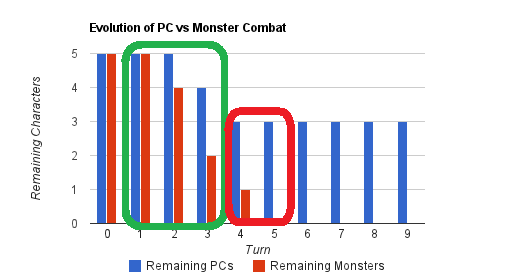
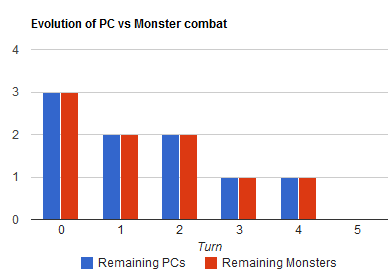
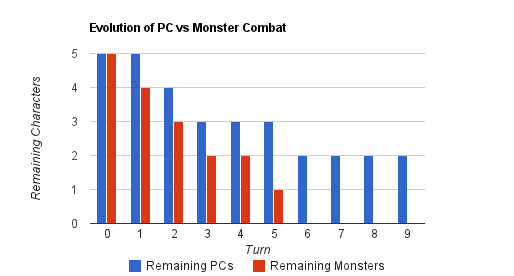 Fig 1 Evolution of # of PCs/Monsters in example encounter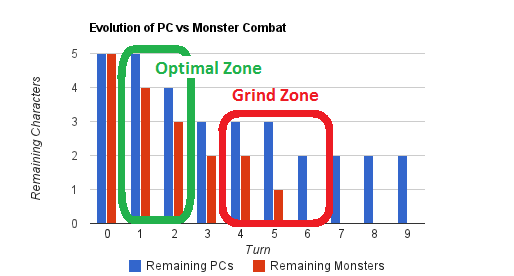

 Posts
Posts


